

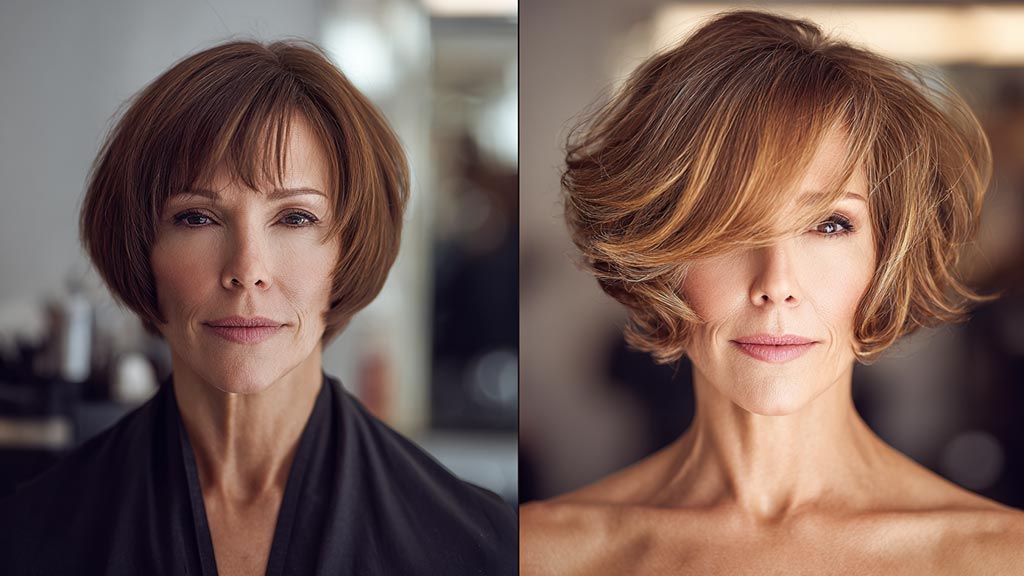
“Your haircut is fighting your face.”
That was the opening line from a seasoned stylist to a client sitting in her chair — a woman in her early 60s with striking blue eyes and a hairstyle that hadn’t evolved since the late 1990s. The client sighed with a hint of resignation, and the colorist leaned in with a warm but direct smile: “You’re not old. Your hairstyle is.”
Across the small neighborhood salon, heads lifted from magazines. Nobody enjoys being told they look dated — but everyone leaned in just a little closer.
The truth is, certain hair habits we hold onto past 50 aren’t expressions of personal style. They’re patterns we never thought to question. And according to experienced hairdressers, a few targeted changes — in shape, color, texture, and movement — can do more for your appearance than any filter or skincare product ever could.
Here are five hair trends that hairdressers say age women after 50, and exactly what to replace them with.
1. The Stiff, Helmet-Style Bob That Refuses to Move
Why It Ages You
You’ve seen it — the ultra-structured bob sitting in a perfect arc around the face, ends tucked under with geometric precision, fringe set firmly in place. While this shape can look polished on a younger woman in a fashion shoot, past 50 it has a particular talent for hardening every feature it frames. Wrinkles appear deeper, the jawline heavier, and the neck more exposed.
From behind, the cut can read as sophisticated. From the front, it often communicates “retired news anchor from a previous decade.”
A Real Salon Story
Stylist Laura recalled a client who had been coming in every four weeks for 15 years to “refresh her bob” — same photograph, same length, same blow-dry every single time. She called it her signature look. When Laura gently showed her a softer, layered variation on her iPad, the woman went completely silent. Then, quietly: “You mean I don’t have to look like this forever?”
They lifted the back slightly, introduced invisible internal layers, and relaxed the volume around the jaw. Her friends were convinced she had undergone a cosmetic procedure. She hadn’t. It was purely the haircut.
The Fix
A rigid bob ages the face because it creates an immovable frame that draws the eye directly to every line and asymmetry. When hair moves and catches light, attention naturally drifts away from fine lines. Incorporating a feather cut technique — where the ends are delicately tapered and softened rather than bluntly cut — introduces effortless movement and a modern lightness that flatters the face beautifully after 50. Even a slightly shattered edge or a few internal layers transforms the silhouette from a geometric shape into something that looks deliberately soft and current.
2. The Flat, One-Dimensional Dark Color That Drains Your Complexion
Why It Ages You
Laura has a term for it: “the black hole brunette.” That near-ink shade that felt bold and dramatic in your 30s can turn into a visual shadow in your 50s, absorbing light rather than reflecting it. The same applies to any very dark, single-tone color — deep chestnut, near-black, or flat dark brown — applied without variation. Against skin that has naturally softened and evolved over the decades, this kind of block color can read as harsh, severe, and even slightly draining.
Dark, flat color doesn’t forgive tired days. It amplifies them — doubling under-eye shadows and pulling warmth away from the complexion.
A Real Salon Story
A 58-year-old client arrived with jet-black dyed hair and a familiar complaint: “Everyone keeps asking if I’m tired. I’m not. I’m just here.” Her natural roots were growing in as a soft salt-and-pepper — the contrast against the dyed ends was stark. Laura’s solution wasn’t a dramatic transformation. She lifted the base by just one to two levels and wove in barely visible caramel and cool beige strands — no chunky highlights, no obvious color blocks, just quiet, natural-looking dimension.
Three hours later, her hair still read as dark — but it reflected light instead of swallowing it. Her skin tone appeared warmer, her eyes noticeably brighter. Same face. Completely different energy.
The Fix
Monochrome dark color competes with your features rather than complementing them. As natural pigmentation softens with age, clinging to the exact shade you wore at 25 creates a visual mismatch — like two photographs edited together. Subtle highlights, lowlights, or a gentle gloss treatment introduce dimension that makes hair look fuller and skin look more luminous. The goal is not to go blonde at any cost — it’s simply to choose a depth that works with your complexion rather than overpowering it.
3. The Shapeless, Extra-Long Length That Pulls the Face Down
Why It Ages You
Think of it as the hair equivalent of clothes you only wear at home — extra-long, structureless length that hangs past the shoulders, almost always destined for a low ponytail or a stretched-out half-bun. The issue isn’t long hair itself. It’s the absence of shape, the weight of thinning ends, and the way unstructured length visually drags the entire face downward.
Many women realize, somewhat suddenly, that their hair hasn’t had a real cut in two years — just occasional “dustings” that changed nothing structurally.
A Real Salon Story
One 63-year-old woman was adamant about keeping her length because her husband loved long hair. The irony was that she wore it pinned up in a clip almost every day, because wearing it loose felt unkempt. Her stylist persuaded her to preserve the length but trim it to the bra line, introduce soft face-framing layers, and clean up the ends. The ponytail remained entirely possible but now it bounced with life rather than dragging downward.
Her husband’s reaction? “You look younger. Did you do something with your makeup?” That is the quiet power of a strategic trim.
The Fix
Limp, excessively long hair creates downward vertical lines that pull the features with them. When ends are thin or wispy, the contrast with fuller roots makes hair appear even sparser. A gentle U-shaped baseline, feather cut layers from the cheekbones downward, or a clearly defined perimeter can shift “tired” into “intentional” almost immediately. The aim isn’t less hair — it’s less unnecessary weight dragging everything south.
4. The Rigid, Hairspray-Locked Style That Doesn’t Move
Why It Ages You
If your hair crunches when touched, it’s time for an honest conversation. The ultra-set blowout, saturated in lacquer, that survives wind, weddings, and every occasion in between sends a very specific message: “I worked very hard on this and I am afraid of it moving.” That fear reads older than the hairstyle itself.
Modern, vital-looking hair is defined by controlled imperfection — a displaced strand, a piece falling softly in front of the ear, a slight lived-in texture. That’s what looks animated and alive.
A Real Salon Story
Laura had a client who visited before every major family event requesting hair that would “last three days, hard as a rock.” Her granddaughter eventually showed her two photographs side by side — one from a heavily lacquered Christmas dinner, one from a beach day where her hair had dried naturally into soft waves. The granddaughter pointed to the beach photo and said simply: “You look like yourself here.”
At the next appointment, they replaced heavy lacquer with flexible mousse and a light texture spray. The style still held — but when she shook her head, her hair actually moved with her.
The Fix
Frozen, stiff styling ages you because it creates emotional distance. It communicates rigidity and fragility — the opposite of ease and confidence. Lighter, more flexible products and a willingness to let a few pieces fall naturally signal something that no amount of precision styling can manufacture: comfort in your own skin. Try these simple swaps:
- Replace high-hold lacquer with a flexible, brushable hairspray
- Apply mousse to damp roots rather than gel to dry ends
- Break apart waves or curls with your fingers once cool — never a stiff brush
- Allow one or two face-framing pieces to sit naturally loose
- Adopt “touchable” as your styling standard, not “indestructible”
“After 50, your hair should move with you, not against you,” Laura said. “A little bounce does more for your face than any ultra-precise blowout.”
5. The Heavy, Face-Covering Fringe That Hides Your Expression
Why It Ages You
The instinct behind a thick fringe is completely understandable — use it as a curtain to conceal forehead lines, fine wrinkles, or skin loosening near the temples. The problem is that a dense, straight-across fringe casts shadows over the eyes, visually compresses the face, and ends up hiding not just forehead lines but the expression behind them.
Eyes are the first thing people look for in a face. Obscuring them with a heavy curtain of hair is the equivalent of turning a dimmer switch on your entire personality.
A Real Salon Story
A client in her late 50s arrived having cut her own fringe with kitchen scissors — a straight-across, too-thick, too-low result born from frustration with how her forehead appeared in selfies. Laura’s solution was to open it through the center and reshape it into soft, feather cut curtain bangs that blended seamlessly into the sides. The original intention — drawing attention away from the forehead — was preserved, but without the visual heaviness that had been flattening her face.
Two weeks later, strangers were complimenting her eyes again. Her forehead hadn’t changed at all. The light on her face had.
The Fix
A wispy, layered fringe that grazes the cheekbones or sits just below the brows can soften lines while keeping the face open and expressive. Diagonal movement, natural gaps between strands, and slightly longer pieces at the sides frame the features rather than concealing them. The goal is a fringe that enhances — not one that functions as a mask.
When you leave the salon, you should feel like a sharper, more luminous version of yourself — not like you’re wearing your hair as camouflage.
Reclaiming Your Hair After 50: Less Rules, More Intention
A quiet but unmistakable shift is happening in salons everywhere. Women over 50 are walking in with Pinterest boards and screenshots, pointing to actresses their age who finally look like real, present-day versions of themselves — and saying: “I don’t want the ‘mature’ cut. I want a me cut.”
The old rulebook — cut it short after a certain age, go dark to mask the grey, lock everything in place — is dissolving under one very clear demand: authenticity.
Hair that genuinely ages you is rarely about length or color in isolation. It’s about whether your hair looks like a deliberate choice — or an unexamined habit carried forward from decades ago.
- → Nationwide Listeria Recall in France: What You Need to Know About Contaminated Pâtés and Cold Meats in 2026
- → The Unexpected Household Hack That Keeps Wet Floors and Entryways Clean in 2026
- → The Hair Transformation Women Over 50 Are Talking About in 2026: What Really Works for Thinning Hair
- → Marseille’s Mistral District in Crisis: Arrests, Secrets, and a Growing Mystery in 2026
- → Massive 35-Meter Waves in the Pacific: What Scientists Are Discovering in 2026
- → Why You’re Receiving More Spam Calls in 2026: The Hidden Reasons and How to Stop Them
- → The Express Chignon: A Quick and Elegant Hairstyle for Busy Women in 2026
Releasing outdated trends isn’t about chasing youth at any cost. It’s about aligning your outward appearance with how you actually feel on the inside. If you’re 55 and more energetic than you were at 35, your hair can either reflect that or contradict it. A subtle lift at the crown, a brighter tone near the face, a feather cut that introduces movement and softness — these are small decisions with a disproportionately large impact on how you present yourself to the world.
You don’t need to cut everything off or go platinum in a single appointment. You can begin with one small act of rebellion against “how you’ve always done it.”
At your next salon visit, ask your stylist one direct question: “Which part of my current hairstyle is aging me the most?” Then genuinely listen. A skilled professional won’t just address length. They’ll speak about movement, texture, light, and confidence. They’ll identify exactly where your hair is pulling your features downward — and where a small adjustment could restore what you thought only filters could provide.
Your hair doesn’t need to pretend you’re 30. It just needs to stop insisting you’re older than you are.
Quick Reference Guide
| Key Principle | What to Do | Benefit for You |
|---|---|---|
| Soft shapes over rigid cuts | Replace helmet bobs and heavy fringes with feather cut layers and movable lines | Features look lifted, less severe, and more contemporary |
| Dimensional color over flat dark tones | Add discreet highlights and lowlights around the face | Brightens complexion and creates fuller-looking hair |
| Touchable styling over stiff set hair | Use flexible products and embrace natural movement | Signals vitality and ease, reducing the overdone effect |
Conclusion
Updating your hair after 50 isn’t about surrendering to age or desperately fighting it — it’s about making intentional choices that genuinely reflect who you are today. Whether it’s swapping a rigid helmet bob for a soft feather cut with internal layers, introducing subtle color dimension to a flat dark base, trimming limp length into a structured and bouncy silhouette, loosening a lacquered style into something touchable, or reshaping a heavy fringe into wispy curtain bangs — each of these changes works with your features rather than against them. The most flattering hair at any age is hair that moves, catches light, and looks chosen. Small, strategic adjustments made with an honest stylist can deliver results that no amount of makeup, skincare, or filtering can replicate. You don’t need a reinvention. You just need a better conversation with your mirror — and your hairdresser.
Frequently Asked Questions (FAQs)
1. Can I keep long hair after 50 without looking outdated? Absolutely — as long as the length has shape and structure. Ask your stylist for light feather cut layers, healthy trimmed ends, and face-framing pieces that encourage movement rather than flat hanging weight.
2. Do I have to go lighter in color as I get older? Not necessarily. Going slightly softer or adding dimension through subtle highlights or a gloss treatment usually helps more than a drastic lightening. Even deep, dark hair can look fresh and modern with the right tonal variation woven through it.
3. How frequently should I reassess my haircut after 50? A full reinvention isn’t required every year, but scheduling an honest review of your cut and color every 12 to 18 months with a candid stylist keeps your look current without constant upheaval.
4. Are bangs flattering past 50? Yes — when they are light, layered, and feathered rather than a dense, blunt block. Curtain bangs or a wispy feather cut fringe that blends into the sides can be genuinely softening and youthful at any age.
5. What is the single easiest change I can make right now? Soften the area closest to your face. Trim the ends, add a few face-framing feather cut strands, and shift your part slightly to one side. These three micro-adjustments alone create an immediate sense of lift and freshness.


Leave a comment