

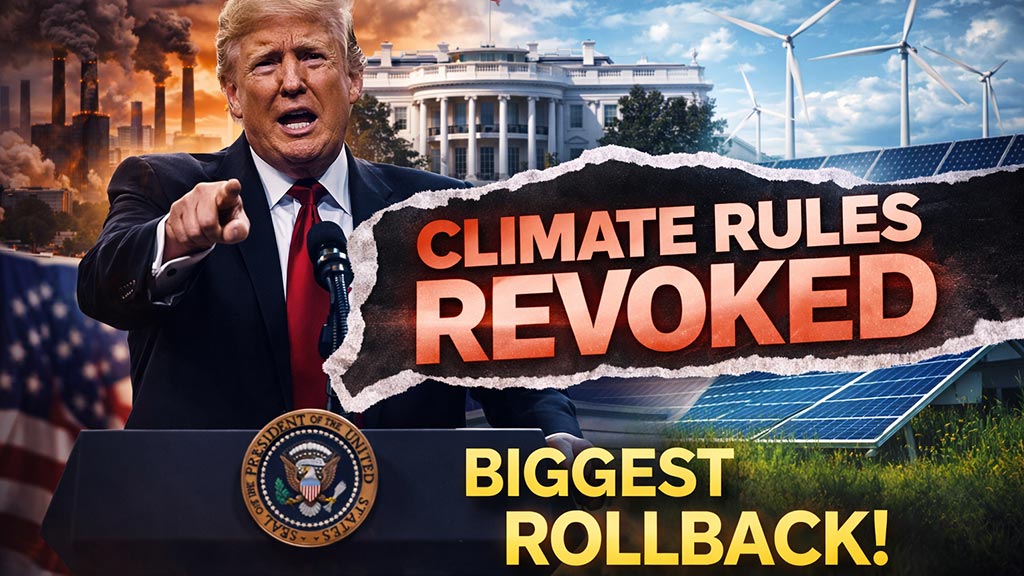
Former President Donald Trump has claimed a significant political and regulatory victory after dismantling a key legal foundation of U.S. climate policy. While his administration portrays the move as economic relief from excessive environmental rules, scientists, Democrats, and advocacy groups warn it could have far-reaching consequences beyond Washington politics.
The Biggest Climate Policy Reversal Yet
At the center of this decision is the repeal of the 2009 “endangerment finding”, a landmark ruling that determined greenhouse gases pose a threat to public health and the environment.
For nearly two decades, this finding served as the legal backbone for federal climate regulations, enabling the government to limit emissions from vehicles, power plants, and industrial sectors.
By removing it, the administration is not just altering specific policies—it is dismantling the legal basis that made such regulations possible.
Trump framed the move as a rejection of what he called “radical green policies,” arguing that it would reduce regulatory burdens and strengthen the economy.
A Sharper Swing in U.S. Climate Policy
Climate policy in the United States has historically shifted with changes in leadership, but this move represents a deeper shift than previous reversals.
- During his first term, Trump withdrew from the Paris Agreement and rolled back multiple environmental protections.
- President Joe Biden later reversed many of those actions, rejoining global climate efforts and introducing clean energy initiatives.
- Now, Trump has not only exited the Paris Agreement again but also targeted the legal structure that allowed emissions regulation in the first place.
Instead of modifying individual rules, this approach eliminates the legal trigger behind them, potentially reshaping future policy options.
Legal and Regulatory Implications
Environmental law experts suggest that removing the endangerment finding could:
- → Nationwide Listeria Recall in France: What You Need to Know About Contaminated Pâtés and Cold Meats in 2026
- → The Unexpected Household Hack That Keeps Wet Floors and Entryways Clean in 2026
- → The Hair Transformation Women Over 50 Are Talking About in 2026: What Really Works for Thinning Hair
- → Marseille’s Mistral District in Crisis: Arrests, Secrets, and a Growing Mystery in 2026
- → Massive 35-Meter Waves in the Pacific: What Scientists Are Discovering in 2026
- → Why You’re Receiving More Spam Calls in 2026: The Hidden Reasons and How to Stop Them
- → The Express Chignon: A Quick and Elegant Hairstyle for Busy Women in 2026
- Undermine existing emission standards for vehicles and power plants
- Make it significantly harder for future administrations to introduce new climate regulations
- Force governments to restart lengthy scientific and legal processes
In essence, the rollback could weaken federal authority to regulate greenhouse gas emissions for years to come.
Politics Over Science?
Trump has consistently questioned climate science, previously labeling global warming as a “hoax.” At the announcement event, the administration downplayed scientific consensus and emphasized economic concerns instead.
EPA Administrator Lee Zeldin described the endangerment finding as the “core pillar” of climate policy and called its repeal one of the largest deregulatory actions in U.S. history.
This aligns with a broader political narrative that frames environmental regulations as economic obstacles rather than necessary protections.
What the Administration Aims to Achieve
According to Trump, the rollback is intended to:
- Increase fossil fuel production
- Lower energy prices
- Support domestic manufacturing
- Reduce costs for consumers, particularly in the auto sector
He also criticized electric vehicle initiatives introduced under Biden, claiming they imposed restrictions on consumers—though those policies primarily relied on incentives rather than mandates.
Expected Impacts
- Greater flexibility for fossil fuel industries
- Reduced pressure on automakers to transition to electric vehicles
- Increased role for state-level regulations
- Intensified legal disputes over environmental responsibilities
Strong Backlash from Democrats and Climate Advocates
The response from environmental organizations and Democratic leaders has been swift and critical.
Former President Barack Obama warned that the decision could make the country “less safe and less healthy,” while benefiting fossil fuel companies.
Critics argue that weakening regulatory foundations may encourage industries to delay transitioning to cleaner technologies and increase pollution levels.
Climate Risks Continue to Grow
The rollback comes at a time when climate-related events are becoming more severe and frequent.
Across the U.S., communities are already experiencing:
- Record-breaking heatwaves
- Worsening wildfires
- Increased flooding and extreme weather
- Rising insurance costs in high-risk regions
Scientists emphasize that these trends are directly linked to climate change, making the policy shift particularly controversial.
A Political Strategy Ahead of Elections
The decision also carries political significance, particularly with midterm elections approaching.
Republicans are positioning the rollback as a defense against costly climate policies, while Democrats argue it undermines long-term environmental and economic stability.
Public opinion remains divided:
- Surveys indicate growing concern about climate change among Americans
- Younger and independent voters increasingly prioritize environmental issues
- Political polarization continues to shape the debate
Understanding the Endangerment Finding
The “endangerment finding” may sound technical, but its purpose is straightforward.
In 2009, the U.S. government officially recognized that greenhouse gases harm public health. This determination legally required the Environmental Protection Agency (EPA) to regulate those emissions under existing laws.
Before vs After Revocation
| Before Revocation | After Revocation |
|---|---|
| Greenhouse gases classified as harmful pollutants | Their legal status becomes contested |
| Clear authority for federal climate regulations | Increased legal uncertainty |
| Consistent regulatory framework | Greater challenges for future policies |
Removing this finding does not immediately erase all regulations, but it weakens the foundation supporting them.
What Happens Next?
Legal challenges are almost certain. Several states and environmental groups are expected to contest the rollback in court.
Possible outcomes include:
- Court rulings that could restore or uphold the decision
- Delays in implementing new climate policies
- Increased state-level regulations, especially in states like California and New York
- A fragmented regulatory landscape across the country
How This Affects Everyday Americans
Although climate regulations may seem distant, they directly influence daily life:
- Fuel efficiency standards affect how often you refuel your car
- Energy policies determine electricity sources and costs
- Climate impacts influence food prices, insurance premiums, and housing risks
The effects of policy changes may not be immediate but tend to accumulate over time.
Key Economic Concepts Behind the Debate
Two important ideas help explain the broader implications:
Externalities
These are hidden costs not reflected in market prices—such as healthcare expenses from pollution or damages caused by climate change.
Lock-in Effect
Decisions made today, like investing in fossil fuel infrastructure, can shape energy systems for decades, making transitions to cleaner alternatives more difficult.
Conclusion
Trump’s decision to revoke the 2009 endangerment finding represents a significant shift in U.S. climate policy. While supporters view it as a step toward economic growth and reduced regulation, critics warn it could weaken environmental protections and delay progress in addressing climate change.
The long-term impact will depend heavily on legal battles, state responses, and future administrations. Ultimately, this move reflects a broader debate between short-term economic priorities and long-term environmental sustainability—one that will continue to shape U.S. policy for years to come.
FAQs
What is the endangerment finding?
It is a 2009 ruling that identified greenhouse gases as harmful to public health, enabling federal climate regulations.
Does revoking it remove all climate rules?
No, but it weakens the legal foundation supporting those regulations.
Why did Trump repeal it?
He argues it will reduce regulatory burdens, lower costs, and boost economic growth.
What are critics concerned about?
They fear increased pollution, weaker protections, and long-term environmental damage.
What happens next?
The decision will likely face legal challenges and could lead to varied state-level regulations.




Leave a comment