

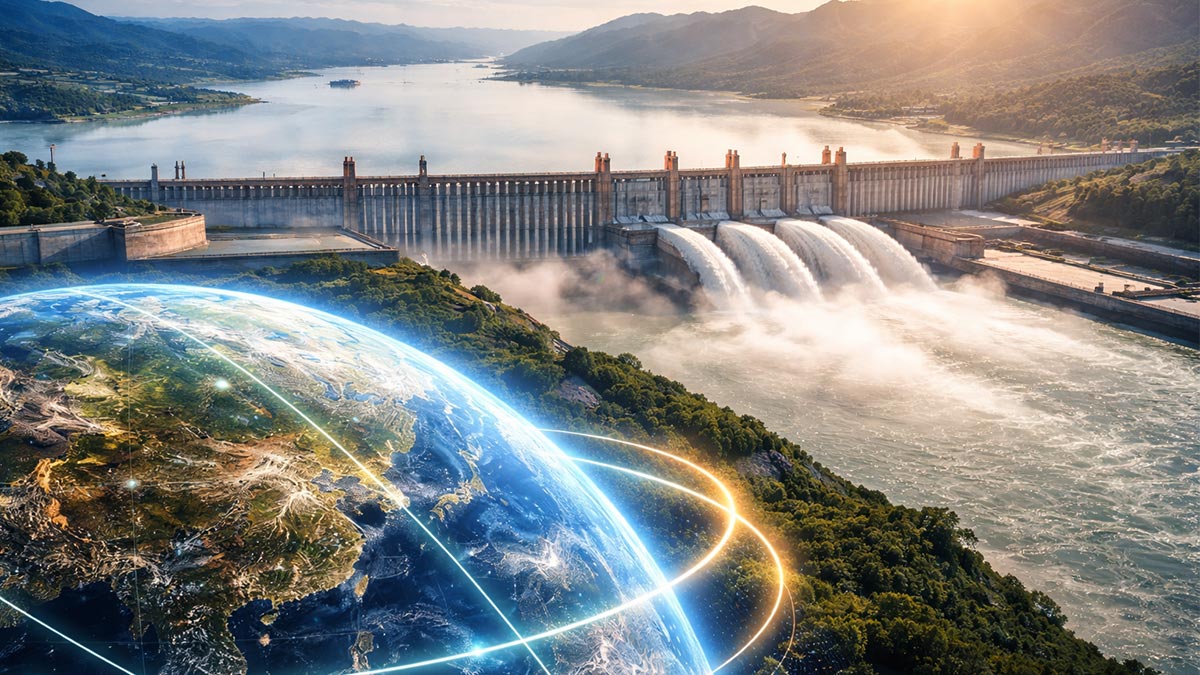
A surprising scientific discussion has emerged around one of the world’s largest engineering projects in China. According to research highlighted by NASA, the sheer scale of this structure may have a measurable—though extremely small—impact on the Earth’s rotation. While the idea may sound dramatic, it is grounded in real physics and has sparked global curiosity about how human activity can influence planetary systems.
The Project at the Center: The Three Gorges Dam
At the heart of this discussion is the Three Gorges Dam, located on the Yangtze River in central China. It is the largest hydroelectric power facility in the world, stretching over 1.4 miles in length and rising approximately 606 feet in height.
Built to generate renewable energy and support China’s economic growth, the dam represents one of the most ambitious infrastructure projects ever undertaken. However, its immense size and capacity have also raised concerns about environmental and geological consequences.
NASA’s Insight: How Mass Can Influence Earth’s Rotation
NASA scientists have explained that the dam’s influence comes from the redistribution of mass. When the reservoir fills, it stores an enormous volume of water, adding significant weight to a specific region of the Earth.
This redistribution slightly alters the planet’s gravitational balance. According to calculations, the effect could slow the Earth’s rotation by approximately 0.06 microseconds per day. While this change is far too small to be noticed in daily life, it is measurable using advanced scientific instruments.
The Science Behind the Phenomenon
The explanation lies in fundamental physics. When mass on Earth is redistributed, it can affect how the planet spins, similar to how a figure skater changes speed by adjusting arm position.
In this case, the massive volume of water stored behind the dam shifts weight across the planet’s surface. Although the change is minuscule compared to Earth’s total mass, it is enough to create a slight alteration in rotational speed.
Potential Global Effects of Even a Tiny Change
Even though the impact is extremely small, scientists consider its broader implications. A slight change in Earth’s rotation could influence systems that rely on precise timing.
Global timekeeping systems, including Coordinated Universal Time, might require minor adjustments over long periods. Navigation technologies such as GPS could also be affected if rotational changes accumulate over time.
These effects remain largely theoretical and would occur over extended periods rather than immediately.
Beyond One Project: A Larger Environmental Question
The discussion surrounding the Three Gorges Dam goes beyond a single structure. It highlights a broader issue—how large-scale human projects can influence natural systems in unexpected ways.
Around the world, countries are investing in massive infrastructure such as dams, reservoirs, and energy facilities. While these projects provide economic and environmental benefits, they can also disrupt ecosystems and alter natural balances.
This case serves as a reminder that even well-intentioned developments can have complex and far-reaching consequences.
Balancing Progress and Environmental Responsibility
The Three Gorges Dam represents both technological achievement and environmental challenge. On one hand, it generates clean energy and supports millions of people. On the other, it has displaced communities and affected ecosystems.
The possibility that it could even influence Earth’s rotation adds another layer to the discussion. It emphasizes the importance of carefully evaluating long-term impacts when planning large-scale projects.
Governments and scientists are increasingly focusing on sustainable development—ensuring that progress does not come at the expense of planetary stability.
Why This Matters in 2026 and Beyond
As global infrastructure continues to expand, understanding the interconnectedness of Earth’s systems becomes more important than ever. Climate change, resource demands, and technological growth all require thoughtful decision-making.
This example highlights how even small physical changes can have ripple effects across multiple systems. It encourages a more holistic approach to engineering, environmental policy, and scientific research.
- → Nationwide Listeria Recall in France: What You Need to Know About Contaminated Pâtés and Cold Meats in 2026
- → The Unexpected Household Hack That Keeps Wet Floors and Entryways Clean in 2026
- → The Hair Transformation Women Over 50 Are Talking About in 2026: What Really Works for Thinning Hair
- → Marseille’s Mistral District in Crisis: Arrests, Secrets, and a Growing Mystery in 2026
- → Massive 35-Meter Waves in the Pacific: What Scientists Are Discovering in 2026
- → Why You’re Receiving More Spam Calls in 2026: The Hidden Reasons and How to Stop Them
- → The Express Chignon: A Quick and Elegant Hairstyle for Busy Women in 2026
Conclusion
The idea that a human-made structure could influence Earth’s rotation may seem extraordinary, but it reflects the complex relationship between human activity and natural systems. While the effect of the Three Gorges Dam is extremely small, it is scientifically valid and measurable.
More importantly, this case serves as a powerful reminder of the scale at which human actions now operate. As we continue to build and innovate, maintaining a balance between development and environmental preservation will be essential for the future of our planet.
FAQs
Can the Three Gorges Dam really slow down the Earth
Yes, but only by a tiny amount—about 0.06 microseconds per day, which is not noticeable in everyday life.
Why does the dam affect Earth’s rotation
Because it redistributes a large amount of mass, which slightly changes the planet’s gravitational balance.
Does this impact daily life
No immediate impact is felt, but scientists study these changes for long-term effects on timekeeping and navigation.
Could other projects have similar effects
Yes, any large-scale redistribution of mass could theoretically influence Earth’s rotation, though the effects are usually extremely small.
Is this a cause for concern
Not directly, but it highlights the importance of understanding the environmental impact of large infrastructure projects.




Leave a comment