

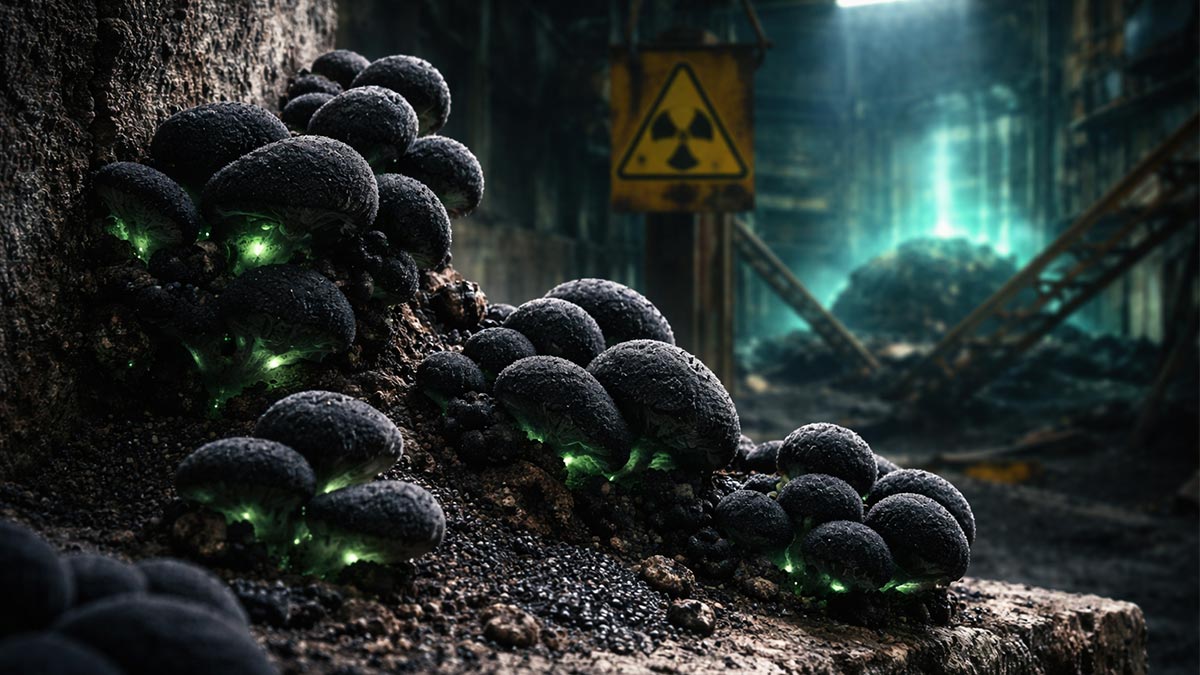
Nearly four decades after the catastrophic explosion at the Chernobyl Nuclear Power Plant, the surrounding exclusion zone remains one of the most radioactive places on Earth. While it is largely uninhabitable for humans, certain forms of life have not only survived but adapted in remarkable ways.
Among the most fascinating discoveries is a black fungus known as Cladosporium sphaerospermum. This organism has drawn global scientific attention because of its unusual ability to grow in high-radiation environments, raising questions about how life can adapt to extreme conditions.
A Hostile Environment That Became a Living Laboratory
When Reactor No. 4 exploded in 1986, it released massive amounts of radioactive material into the environment. The resulting exclusion zone has since become an unintended scientific laboratory where researchers study how organisms respond to radiation.
Interestingly, the absence of human activity has allowed ecosystems to recover in unexpected ways. Plants, animals, and microorganisms have returned to the region, but it is the behavior of certain fungi that has proven particularly intriguing.
Inside highly contaminated structures near the reactor, scientists observed colonies of dark-colored fungi thriving on walls exposed to intense radiation.
Discovery of Radiation-Loving Fungi
The first major insights into these fungi came in the late 1990s, when a research team led by microbiologist Nelli Zhdanova conducted field studies within the exclusion zone.
The team identified 37 different fungal species living in the area. Many of them were dark in color, rich in a pigment called melanin. Among these, Cladosporium sphaerospermum stood out as one of the most dominant and radiation-tolerant species.
The presence of melanin suggested that these fungi might possess unique protective or adaptive mechanisms.
How Ionizing Radiation Affects Living Organisms
To understand the significance of this discovery, it is important to consider the effects of ionizing radiation.
Ionizing radiation is powerful enough to strip electrons from atoms, disrupting molecular structures. In most living organisms, this can damage DNA, interfere with cellular processes, and ultimately lead to cell death.
This destructive capability is why radiation is used in cancer treatments. However, for organisms like Cladosporium sphaerospermum, the effects appear to be very different.
A Surprising Scientific Observation
Further studies led by researchers such as Ekaterina Dadachova and Arturo Casadevall revealed that exposure to ionizing radiation did not harm this fungus. In fact, the organism appeared to grow more efficiently under such conditions.
This unexpected behavior challenged traditional assumptions about radiation and life. Instead of being damaged, the fungus seemed to benefit from its environment.
Researchers also observed that radiation altered the chemical behavior of melanin within the fungus, suggesting a possible link between the pigment and its survival strategy.
The Theory of Radiosynthesis
In 2008, scientists proposed a groundbreaking hypothesis known as radiosynthesis. This theory suggests that certain fungi may be capable of converting ionizing radiation into usable energy, similar to how plants convert sunlight through photosynthesis.
In this model, melanin would act like chlorophyll, absorbing radiation and transforming it into a form of energy that supports growth.
While this idea is compelling, it remains a theory. Scientists have yet to conclusively demonstrate a full energy-conversion pathway or confirm that the fungus gains measurable metabolic energy directly from radiation.
Evidence from Space Experiments
Interest in this unique fungus has extended beyond Earth. In a 2022 experiment, samples of Cladosporium sphaerospermum were sent to the International Space Station to study its interaction with cosmic radiation.
The results were striking. Sensors placed beneath the fungal samples detected lower radiation levels compared to control samples without the fungus. This suggests that the organism may have the ability to absorb or block radiation.
While the experiment was primarily designed to explore radiation shielding for space travel, it provided additional evidence of the fungus’s unusual properties.
Other Radiation-Resistant Fungi
Cladosporium sphaerospermum is not the only organism displaying resilience to radiation.
For example, Wangiella dermatitidis has been observed to grow more rapidly when exposed to radiation. Another species, Cladosporium cladosporioides, shows increased melanin production under radiation, although it does not necessarily grow faster.
These findings indicate that radiation resistance may be a broader phenomenon among melanized fungi, although the exact mechanisms vary between species.
Unanswered Questions in Modern Science
Despite years of research, scientists still do not fully understand how these fungi interact with radiation.
Key questions remain unresolved. Researchers have not yet demonstrated clear evidence of carbon fixation driven by radiation, nor have they identified a definitive metabolic pathway that converts radiation into usable energy.
Some scientists believe the observed effects could be a stress response rather than a true energy-harvesting process. Others argue that it may represent a previously unknown biological adaptation.
For now, the concept of radiosynthesis remains an intriguing but unproven idea.
What This Discovery Means for Science and the Future
The study of radiation-resistant fungi has implications far beyond Chernobyl.
If these organisms can indeed absorb or neutralize radiation, they could play a role in developing new technologies for radiation protection. This could be particularly valuable for space exploration, where exposure to cosmic radiation is a major challenge.
Additionally, understanding these mechanisms could lead to advances in medicine, environmental cleanup, and even energy research.
Life’s Ability to Adapt
The story of Cladosporium sphaerospermum highlights one of the most fundamental truths of biology: life has an extraordinary ability to adapt.
In an environment that is lethal to humans, this fungus has found a way not just to survive, but possibly to thrive. Whether through radiosynthesis or another unknown mechanism, it represents a fascinating example of resilience in the natural world.
- → Nationwide Listeria Recall in France: What You Need to Know About Contaminated Pâtés and Cold Meats in 2026
- → The Unexpected Household Hack That Keeps Wet Floors and Entryways Clean in 2026
- → The Hair Transformation Women Over 50 Are Talking About in 2026: What Really Works for Thinning Hair
- → Marseille’s Mistral District in Crisis: Arrests, Secrets, and a Growing Mystery in 2026
- → Massive 35-Meter Waves in the Pacific: What Scientists Are Discovering in 2026
- → Why You’re Receiving More Spam Calls in 2026: The Hidden Reasons and How to Stop Them
- → The Express Chignon: A Quick and Elegant Hairstyle for Busy Women in 2026
Conclusion
The discovery of radiation-resistant fungi in Chernobyl has reshaped our understanding of life in extreme environments. Cladosporium sphaerospermum, in particular, stands out as a remarkable organism that challenges conventional scientific assumptions.
While the theory of radiosynthesis remains unconfirmed, ongoing research continues to uncover new insights into how life interacts with radiation. These findings could have far-reaching implications, from improving radiation shielding to advancing our understanding of biology itself.
As scientists continue to investigate this phenomenon, one thing is clear: even in the most hostile conditions, life can find unexpected ways to endure and evolve.
FAQs
What is Cladosporium sphaerospermum
It is a type of black fungus known for its ability to survive and grow in high-radiation environments.
What is radiosynthesis
Radiosynthesis is a proposed process where organisms convert radiation into energy, similar to how plants use sunlight.
Is radiosynthesis proven
No, it remains a theory and has not yet been conclusively demonstrated.
Why is this fungus important
It may help scientists develop new ways to protect against radiation and understand life in extreme environments.
Can this fungus be used in space
Research suggests it could potentially be used as a natural radiation shield for future space missions.




Leave a comment