

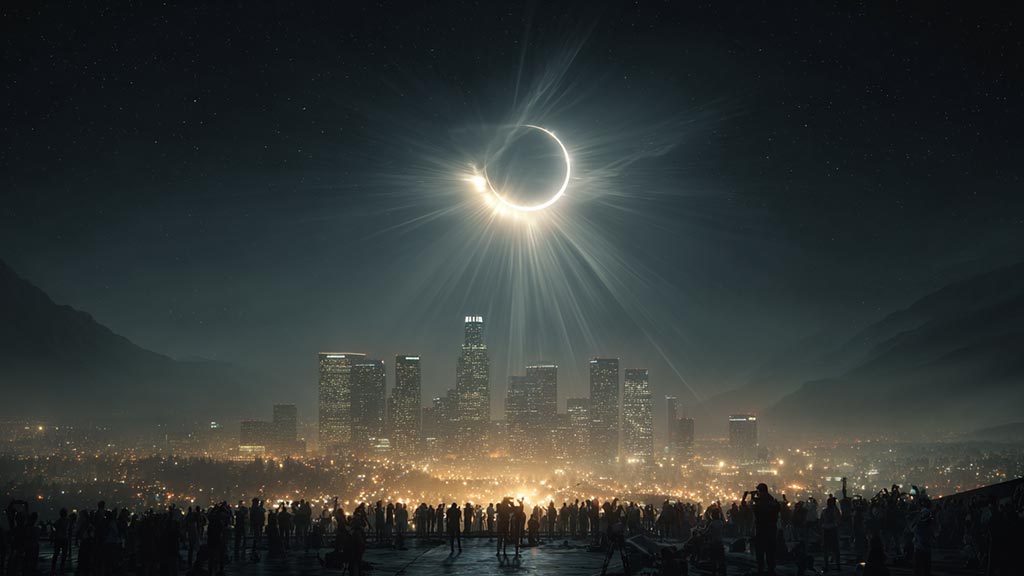
When the Sun Disappears and the World Holds Its Breath
It was the middle of the afternoon, yet the city felt suddenly transformed — muffled sounds, slower footsteps, children falling inexplicably quiet. Now scientists have confirmed that the next event will push every one of those sensations to a new extreme. Longer totality, deeper darkness, visible to tens of millions of people — and arriving wrapped in equal parts celebration, panic buying, and apocalyptic prophecy.
While some are already scouting Instagram locations, others are stocking candles and bottled water. Scientists stand in the middle, celebrating a measurable record while simultaneously watching the storm they’ve triggered. Rarely has a purely astronomical event ignited this much hope, fear, and outrage at the same time. And a single question hangs over all of it like a shadow that refuses to lift.
- → Nationwide Listeria Recall in France: What You Need to Know About Contaminated Pâtés and Cold Meats in 2026
- → The Unexpected Household Hack That Keeps Wet Floors and Entryways Clean in 2026
- → The Hair Transformation Women Over 50 Are Talking About in 2026: What Really Works for Thinning Hair
- → Marseille’s Mistral District in Crisis: Arrests, Secrets, and a Growing Mystery in 2026
- → Massive 35-Meter Waves in the Pacific: What Scientists Are Discovering in 2026
- → Why You’re Receiving More Spam Calls in 2026: The Hidden Reasons and How to Stop Them
- → The Express Chignon: A Quick and Elegant Hairstyle for Busy Women in 2026
A Record Eclipse That Leaves Nobody Unmoved
More Than Just Numbers
When researchers use the phrase “record-breaking solar eclipse,” it initially sounds like dry data — minutes of totality, shadow diameter, luminosity drop measured in lux. But anyone who has stood outdoors as the sun vanishes mid-afternoon understands immediately that this is no abstract experiment. It is a deeply physical experience. The air shifts. Birds go silent. Streetlights flicker on in confusion. Entire cities are expected to be submerged in an eerie, near-twilight darkness for several consecutive minutes. That prospect is precisely what one group of people is treating as a once-in-a-lifetime spectacle — and precisely what another group is treating as a genuine threat. Two camps, one sky.
The Economy of Anticipation
In American cities positioned along the totality corridor, the tension is already visible in shop windows. Specialist filter glasses, eclipse-branded merchandise, hotels offering dedicated “Eclipse Packages.” Towns that rarely appear on any meaningful map have been fully booked for months. Campgrounds are overwhelmed. Car parks are being converted into makeshift overflow areas. Traffic authorities are warning of gridlock that will make any holiday weekend look manageable by comparison.
Simultaneously, Telegram groups are circulating videos from self-appointed prophets speaking of “cosmic cleansing” and cautioning followers about “energetic darkness.” One family cheerfully packs picnic blankets and cameras. Their neighbour is seriously weighing whether to keep her children indoors for the duration. The sun has become a mirror in which our deepest anxieties and longings are reflected back at us with uncomfortable clarity.
The Science Behind the Spectacle
Astrophysicists explain the record duration with characteristic calm: the precise orbital path of the Moon, Earth’s position, and minor variations in distance and angular alignment combine to produce an unusually extended period of totality. Viewed through a purely physical lens, it is a perfect coincidental alignment within the solar system — nothing more.
Socially, however, it is considerably more than that. Events of this magnitude have a peculiar ability to expose the thin layer that modern rationalism has laid over ancient mythology. The scientific explanations are clear and unambiguous. And yet the primal narrative of “the sun disappearing” — the cosmic rupture, the brief suspension of ordinary reality — runs directly beneath the surface of even the most evidence-based conversation. It is this collision between intellectual understanding and instinctive feeling that produces such an intense emotional response. We know exactly what is happening. And still, something in us insists that this day will feel different.
What Cities Will Actually Experience
For urban areas falling within the path of the umbral shadow, the practical reality is stark: lights out, temperatures dropping, behavioural patterns thrown into a kind of collective emergency mode. People who never ordinarily glance up from their phones will be standing together on rooftops and car park levels, waiting with the focused attention usually reserved for live music.
Meanwhile, transit authorities, police forces, and hospital emergency departments are preparing for a genuine operational stress test. More people outdoors, more distraction, more heightened emotion — this is not theoretical planning, it is routine logistics scaled up to extraordinary circumstances. And throughout all of it, the same question persists: will this produce the peaceful collective wonder that optimists anticipate, or the disorder that pessimists predict?
The Environmental Cost of Chasing Darkness
A Spectacle With a Footprint
One concern that deserves far more attention than it currently receives is the environmental impact. During the last major eclipse event, the zones of visibility documented shocking volumes of waste in their aftermath: single-use viewing glasses, plastic bottles, packaging from eclipse-themed food products. This time, certain regions are bracing for several hundred thousand additional visitors — all arriving for a few minutes of darkness.
That sounds poetic until you consider what it means in terms of sewage capacity, energy consumption, and solid waste management. There is something genuinely uncomfortable about a natural phenomenon that reminds us of our planet’s fragility simultaneously generating fresh environmental damage. And this says nothing of the carbon footprint accumulated by those flying in specifically to capture the perfect video clip. While the scientific community celebrates the precision of the orbital calculations, local communities are left managing far more mundane consequences: overflowing portable toilets, gridlocked roads, and rubbish bins that stopped being adequate three days ago.
The Psychological Dimension Nobody Wants to Discuss
When Darkness Triggers More Than Wonder
Beyond the logistical pressures lies a dimension that receives far too little coverage: psychological responses. Not everyone processes this artificially induced midday darkness comfortably. Older individuals may find it involuntarily recalls wartime accounts of blacked-out cities. Children struggle to make sense of the mixture of adult excitement and underlying unease that surrounds them. Emergency response professionals are genuinely anticipating an uptick in crisis calls, panic episodes, and circulatory incidents during the event window.
Then there are the spiritual interpretations, which range widely and sincerely. For certain communities, a solar eclipse is a sacred occurrence. For others, it represents a warning. For others still, it is pure theatre. When scientists appear on television cheerfully discussing “a breathtaking record,” people who experience this event as something frightening or spiritually significant frequently feel dismissed entirely. Two separate realities are colliding here, and neither has much capacity to explain itself to the other.
On the Ground: What Communities Are Actually Facing
An environmental sociologist consulted for this piece put it plainly: “We are confronting one of the most impressive natural spectacles of our era — and simultaneously a significant social stress test. The shadow of the sun is not the problem. What we project into that shadow is.”
She described communities that are simultaneously proud of the expected visitor influx and quietly anxious about vandalism, overcrowding, and organised gatherings by spiritually motivated groups at rural sites that ordinarily see only hikers. Some networks are planning deliberate mass meetings at ancient landmarks and places of perceived spiritual significance. In parallel, municipal cultural offices are constructing official viewing zones complete with live music, food vendors, and managed security perimeters. Two entirely different relationships with the same sky. And threading through both is a quiet worry that a brief magical moment might leave behind a lengthy list of problems.
How to Experience This Without Losing Your Mind
Choosing Your Setting Deliberately
A practical approach to this day begins with a single question: where do you actually want to be when the shadow arrives? Those who dislike large crowds have no obligation to position themselves at the epicentre of the spectacle. A quieter rooftop, a field on the urban outskirts, or a balcony with some distance from the collective noise are all entirely valid choices. This event is equally available to those who experience it quietly and alone.
For those who do intend to join larger gatherings, approaching the day as you would a small outdoor festival makes sense: build generous travel time into your plans, carry water and snacks, allow for rest breaks, and resist the compulsion to film every single second. These unremarkable practical decisions will ultimately determine whether the moment feels magical or merely exhausting.
Protecting More Than Just Your Eyes
The standard warning about retinal damage from unfiltered viewing is well established. Less discussed is protecting the psychological experience — particularly for children, pets, and people with anxiety disorders, for whom sudden midday darkness can be intensely overwhelming. No filter addresses that. What does help is an honest conversation beforehand: explain what will happen, invite questions, and resist making anyone feel foolish for preferring to stay indoors.
The truth is that very few people spend meaningful time developing comfort with their own reactions to extraordinary stimuli. That is precisely why events like this can feel so destabilising — we encounter our own responses before we’ve had any chance to anticipate them. A backup location, a clear plan, and permission to simply not look if it feels like too much — none of that is dramatic. All of it is sensible self-care.
The Behaviours That Will Ruin It
Certain patterns emerge reliably around events of this kind, and recognising them in advance is genuinely useful:
Filming everything and feeling nothing — experiencing the entire moment through a screen rather than through your own senses means missing the thing you travelled to witness. Abandoning basic consideration — from illegal parking on private farmland to discarding rubbish in protected natural areas, the pursuit of the perfect vantage point produces damage that outlasts the memory of the event itself. Dismissing safety warnings — eclipse viewing without properly certified eyewear carries real consequences, and the ophthalmologist’s waiting room is not an improvement on the spectacle. Invalidating others’ fear — particularly with children or people of spiritual sensitivity, this approach creates unnecessary conflict and achieves nothing. Arriving with transformative expectations — when a solar eclipse is burdened with the pressure to be a life-changing experience, the inevitable result is disappointment. It is a rare and remarkable thing. That is already enough.
Conclusion
A solar eclipse does not change the world. What it does is change, briefly and completely, how we perceive it. For the few minutes that the shadow holds, ordinary life pauses — and something older, stranger, and harder to categorise takes its place.
This particular event is exceptional by any measurable standard, and the scientific community is right to document it carefully. But the more revealing story is not in the orbital calculations. It is in the full spectrum of human response that surrounds them: the wonder and the anxiety, the celebration and the dread, the communities bracing for impact and the individuals quietly choosing a rooftop away from the crowd.
The question worth sitting with afterward is not how many photographs you managed to take, or whether the totality met your expectations. It is whether you allowed yourself to actually feel the strangeness of the moment — the unsettling, beautiful, deeply human experience of standing in unexpected darkness and remembering, briefly, how fragile ordinary light really is.
Frequently Asked Questions
Will cities genuinely go dark during totality? Not to the level of a moonless night, but considerably darker than typical overcast conditions. The sky takes on an unusual blue-grey twilight quality, in which street lighting and illuminated signage become noticeably prominent. The effect is striking and disorienting even for those who expect it.
Can the eclipse cause lasting environmental or weather changes? Not directly. Temperatures drop briefly by several degrees during totality, and wildlife responds visibly, but no permanent effects result from the eclipse itself. The more significant and lasting environmental impacts come from the human activity surrounding it — traffic, waste generation, and mass visitor influx to unprepared areas.
Is anxiety about spiritual disruption a reasonable response? Physically, there is no basis for it. Emotionally, it is entirely understandable. People who already carry heightened sensitivity or stress may find themselves strongly affected by the symbolic weight of the event. Those feelings are real and valid, regardless of how straightforwardly the astronomical mechanics can be explained.
What is the safest way to view the eclipse? Only use certified eclipse-viewing glasses that meet recognised safety standards such as ISO 12312-2. Never look through standard sunglasses, camera viewfinders, or improvised filters. Remove glasses immediately if you feel uncertain about their integrity. During the brief window of complete totality, unfiltered viewing is safe — but the moment totality ends, certified eyewear must be replaced immediately.
Is travelling into the totality zone worth it? For many people, the difference between partial and total coverage is so profound that the journey feels entirely justified. If the travel costs, logistical demands, and environmental considerations are manageable for your circumstances, it can be a genuinely extraordinary experience. It is not, however, a requirement for finding meaning in the day.




Leave a comment