

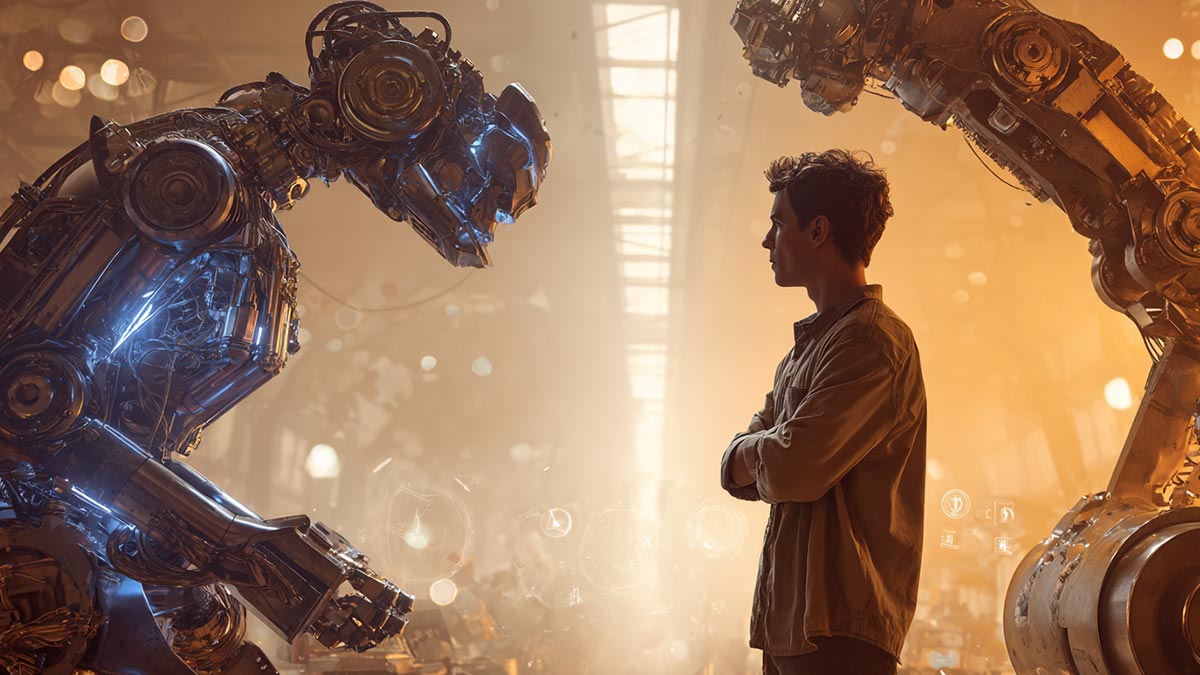
Across factory floors and corporate boardrooms alike, one question is growing impossible to ignore: as automation accelerates, will human workers be freed — or simply replaced? Three of the world’s most influential minds — Nobel-winning physicist Dr. Michio Kaku, Tesla and SpaceX CEO Elon Musk, and Microsoft co-founder Bill Gates — have each stepped into this debate with distinct and thought-provoking viewpoints.
Their combined insights paint a picture of a world on the cusp of a profound transformation — one where the very definition of work, income, and free time may need to be completely rewritten.
Dr. Michio Kaku: Automation as Liberation
Among the three voices, Nobel Laureate Dr. Michio Kaku holds the most sweeping outlook. In his view, the gradual takeover of human labor by machines is not a catastrophe to be feared — it is an inevitable evolution to be prepared for.
Kaku argues that automation will progressively render traditional employment redundant across a wide swath of industries — from manufacturing assembly lines to transportation networks and even portions of the service economy. Artificial intelligence and robotics, he contends, will absorb the repetitive, time-consuming tasks that currently occupy much of the global workforce.
Rather than mourning this shift, Kaku sees it as an opportunity for humanity to redirect its energy toward creativity, learning, and personal fulfillment. To make this transition viable, he champions the adoption of a Universal Basic Income (UBI) — a government-administered system in which every citizen receives a regular, unconditional financial allowance. In Kaku’s framework, UBI is not a luxury but a necessity: the social safety net that will allow societies to remain stable as economic structures undergo radical change.
Elon Musk: Cautious Optimism With a Safety Net
Elon Musk approaches the automation question with a blend of enthusiasm and awareness. On one hand, he genuinely believes that machines taking over repetitive and physically demanding work will be a net positive for humanity — clearing the path for people to invest their time in more intellectually rewarding, creative, and purpose-driven activities.
Musk envisions a future of genuine abundance — not just material wealth, but an abundance of time and human potential. When machines handle the mundane, people are freed to innovate, build relationships, pursue artistic endeavors, and engage more deeply with their communities.
That said, Musk does not sidestep the disruptive reality of this transition. He openly acknowledges that large-scale job displacement will create serious economic and social turbulence — and like Kaku, he sees Universal Basic Income as a critical mechanism for cushioning the impact. For Musk, UBI is the bridge between the world we have today and the more liberated, post-scarcity society he believes automation can eventually deliver.
Bill Gates: Grounded Realism and the Middle-Class Warning
Where Kaku and Musk lean toward transformative optimism, Bill Gates plants his feet more firmly on the ground. He acknowledges automation’s disruptive force but is equally focused on the complications it brings — particularly for working and middle-class populations.
Gates accepts that certain jobs will disappear and that technology will reshape entire industries. However, he counters that new categories of work will emerge in their place — particularly in domains demanding human creativity, emotional intelligence, and complex problem-solving. The key, in his view, is equipping the workforce with the right skills to pursue these emerging opportunities.
Gates places heavy emphasis on education reform and skills development as the most practical tools for navigating this transition. He warns, however, that without deliberate policy intervention, automation could dramatically widen the already significant gap between the wealthy and everyone else. If the economic gains generated by automation flow disproportionately to the top, the middle class faces a serious squeeze — and with it, the risk of rising inequality and social instability. Gates advocates for targeted policies that ensure the benefits of technological progress are distributed more equitably across society.
Side-by-Side: Where the Three Visions Align and Diverge
Despite their differing tones, all three figures agree on several fundamental points. Each recognizes automation as an unstoppable force. Each acknowledges that job displacement is real and demands a serious policy response. And each — to varying degrees — supports mechanisms like UBI or skills investment to protect those left vulnerable by the transition.
Where they diverge is in scope and emphasis. Kaku is the most visionary, framing automation as a civilizational upgrade. Musk occupies a middle ground — idealistic about the destination but realistic about the turbulence along the way. Gates is the most pragmatic, less focused on utopian outcomes and more concerned with concrete, near-term policy solutions that protect ordinary workers from being left behind.
The Jobs Most at Risk
Identifying which sectors face the steepest automation risk is essential for effective planning. The consensus among experts points to several industries as particularly exposed.
Manufacturing sits at the top of the list, with robotics already reshaping production lines and reducing the demand for manual labor. Transportation faces disruption through autonomous vehicle technology, which threatens to fundamentally alter driver-dependent roles. Administrative and clerical work — tasks involving data entry, document processing, and routine communication — is increasingly being handled by AI-powered software.
Food service faces moderate disruption as automated food preparation technologies gain traction, while healthcare is seeing growing automation in diagnostics and routine procedures — though the sector is also expected to generate new roles requiring human judgment and care.
Crucially, the speed of this transition will not be uniform. Geography, industry structure, and regulatory environments will all shape how quickly — and how deeply — automation reshapes specific labor markets.
Redefining What “Free Time” Actually Looks Like
One of the more philosophically interesting dimensions of this debate is what a world with less mandatory work would actually feel like. The experts suggest it need not mean idle hours in front of a screen.
- → Nationwide Listeria Recall in France: What You Need to Know About Contaminated Pâtés and Cold Meats in 2026
- → The Unexpected Household Hack That Keeps Wet Floors and Entryways Clean in 2026
- → The Hair Transformation Women Over 50 Are Talking About in 2026: What Really Works for Thinning Hair
- → Marseille’s Mistral District in Crisis: Arrests, Secrets, and a Growing Mystery in 2026
- → Massive 35-Meter Waves in the Pacific: What Scientists Are Discovering in 2026
- → Why You’re Receiving More Spam Calls in 2026: The Hidden Reasons and How to Stop Them
- → The Express Chignon: A Quick and Elegant Hairstyle for Busy Women in 2026
Kaku envisions freed-up time as an opportunity for individuals to pursue passions they never had space for — artistic projects, community building, intellectual exploration, and lifelong learning. Musk echoes this, describing a future where human energy is redirected from grinding labor toward genuine self-actualization.
But realizing this vision requires deliberate infrastructure. Equitable access to education, community resources, and creative outlets cannot be taken for granted — they must be actively built and funded. Without this, “free time” risks becoming a burden rather than a gift, particularly for those who lose jobs without adequate support systems to replace the structure and purpose that work provides.
Policy Challenges That Cannot Be Ignored
Translating these visions into workable policy is where the real complexity begins. Universal Basic Income — the flagship proposal from both Kaku and Musk — is still a deeply contested idea. Questions about how to fund it sustainably, how to prevent inflationary effects, and how to structure eligibility remain unresolved in most national policy conversations.
Meanwhile, Gates’ emphasis on workforce development requires substantial and sustained investment in educational institutions, vocational training programs, and public-private partnerships. Businesses also have a role to play — those that invest proactively in reskilling their employees will be far better positioned to thrive in an automated economy than those that simply downsize.
The political will to act — and to act equitably — remains one of the most significant barriers standing between today’s workforce and a well-managed transition.
How Individuals and Communities Can Respond Now
Waiting for top-down policy solutions is not a strategy. Experts consistently stress that individuals and communities have meaningful agency in preparing for what is coming.
At the personal level, cultivating adaptability is the most valuable asset anyone can develop. This means embracing continuous learning, building transferable skills, and maintaining a willingness to pivot professionally as the market evolves. Technical literacy, digital fluency, and creative problem-solving capabilities will be in growing demand regardless of how automation unfolds.
At the community level, local governments, nonprofits, and businesses can collaborate to establish retraining hubs, entrepreneurship incubators, and peer support networks for workers navigating displacement. The communities that build these ecosystems early will be far more resilient than those that react only after disruption has already arrived.
Automation Risk by Sector
| Sector | Automation Risk | Likely Impact |
|---|---|---|
| Manufacturing | High | Job displacement, efficiency gains |
| Transportation | High | Autonomous shift, new skill demands |
| Administrative/Clerical | High | AI-driven processes, role restructuring |
| Food Service | Moderate | Partial automation, job changes |
| Healthcare | Moderate | Diagnostic automation, new human roles |
Expert Snapshot
| Expert | Core View | Key Recommendation |
|---|---|---|
| Dr. Michio Kaku | Automation liberates humanity | Implement Universal Basic Income |
| Elon Musk | Automation enables abundance, but needs safeguards | Advocate for UBI and proactive transition support |
| Bill Gates | Automation creates and destroys jobs; inequality is the real risk | Invest in education, skills training, and equitable policy |
Conclusion
The forecasts offered by Michio Kaku, Elon Musk, and Bill Gates are not scare stories — they are urgent invitations to think carefully about where unchecked automation leads, and what proactive stewardship of this transition could look like. Whether the future holds liberation or displacement will depend less on the machines themselves and more on the choices governments, businesses, and individuals make in the years immediately ahead.
UBI, skills investment, education reform, and community resilience are not competing ideas — they are complementary pillars of a coherent response. The window to act thoughtfully is still open, but it will not stay open indefinitely. The conveyor belt of automation does not pause while humanity deliberates.
FAQs
What is Dr. Michio Kaku’s main argument about automation and jobs? Kaku believes automation will progressively eliminate the need for human labor across many industries, ultimately liberating people to pursue more meaningful and creative lives. He considers Universal Basic Income an essential policy response to this shift.
How does Elon Musk view the relationship between automation and human freedom? Musk sees automation as a pathway to abundance — a future where humans are freed from repetitive work and can channel their energy into more fulfilling, creative pursuits. He also supports UBI as a cushion against the economic disruption that will accompany this transition.
What distinguishes Bill Gates’ perspective from the other two? Gates is more focused on near-term risks, particularly the danger that automation could deepen income inequality by squeezing the middle class. He prioritizes education, reskilling, and targeted policy interventions over broader utopian frameworks.
Which industries face the highest risk from automation? Manufacturing, transportation, and administrative or clerical roles are considered most vulnerable, as they involve repetitive, rule-based tasks that are highly susceptible to being handled by machines or AI systems.
Is Universal Basic Income a realistic solution to automation-driven job loss? It remains a hotly debated proposal. While Kaku and Musk both advocate for it, significant questions about funding, sustainability, and potential unintended economic consequences have yet to be fully resolved by policymakers.
What can workers do today to protect themselves from automation? Building adaptable, transferable skills — particularly in digital literacy, creative problem-solving, and emotional intelligence — is widely recommended. Committing to lifelong learning and remaining open to professional reinvention are equally critical strategies.
Will new jobs emerge to replace those lost to automation? Gates and many economists argue yes — new categories of work will emerge, especially in fields requiring human creativity and judgment. However, the transition will not be automatic or painless, and proactive reskilling will be essential to access these new opportunities.




Leave a comment