

That Frustrating Moment Every Household Knows
The water sits there, barely moving. A murky pool of soap residue, food remnants, and slow-swirling debris that simply refuses to drain. You switch off the tap, step back, and wait — but the water just stares back at you, completely indifferent to gravity.
Then comes the smell. That distinctive blend of stale food and damp pipework that makes the entire kitchen feel grimy regardless of how recently you cleaned it.
You remember the last time you tipped half a box of baking soda down there, followed it with a dramatic glug of vinegar, and watched the satisfying fizz. It looked impressive. It smelled like a science experiment. And within two days, the drain was sluggish all over again.
Somewhere between viral cleaning hacks and harsh chemical gels, there is a quieter, more effective solution — and it requires neither vinegar nor baking soda.
What Is Actually Lurking Inside Your Drain
Blocked drains rarely announce themselves dramatically from the start. The deterioration is gradual — a few extra seconds for water to disappear here, a faint background odour there. Over weeks and months, those minor inconveniences become a fixture of daily life, quietly accepted and consistently ignored.
Then one morning the sink fills halfway while you are brushing your teeth, and the reality becomes impossible to dismiss.
By that point, the blockage has already established itself deep within the pipework — invisible but very much present. If you could see inside a typical kitchen or bathroom drain pipe, the interior would likely be startling: a dense, layered accumulation of solidified fat, decomposed soap, shed skin cells, hair, limescale deposits, pasta fragments, coffee grounds, and microscopic food fibres.
One plumber described it memorably as “a lasagna of gunk” — not a flattering image, but an accurate one. Water initially squeezes through the gaps within this buildup. Over time, those gaps narrow, harden, and the pipe gradually reduces to a constricted channel barely capable of handling normal water flow.
Why Vinegar and Baking Soda Often Fall Short
The vinegar and baking soda combination appears in virtually every home cleaning guide, and it does produce results — just not always the ones the problem requires.
The dramatic fizzing reaction that makes this method so visually satisfying is primarily carbon dioxide gas escaping, not a powerful chemical process dissolving years of compacted organic matter. The foam may dislodge light surface residue near the drain opening, but dense, greasy, mineral-heavy blockages further down the pipe are largely unaffected.
Grease and limescale in particular resist these mild household acids effectively. Hot water pushes them slightly further along, then cools and allows them to reattach at a deeper point in the system. The blockage does not disappear — it simply relocates.
Addressing a genuine drain blockage requires something capable of flowing through the pipe, adhering to the interior walls, softening accumulated deposits, and breaking them down thoroughly — without causing damage to the pipework in the process.
The Half-Glass Method That Works While You Sleep
What Enzymatic Drain Cleaner Actually Does
The solution that experienced plumbers and long-serving building caretakers consistently reach for is enzymatic drain cleaner — a biological product containing live bacteria and enzymes specifically cultivated to break down organic waste.
The application could not be simpler:
- In the evening, once you have finished using the sink, remove any visible debris from the drain opening
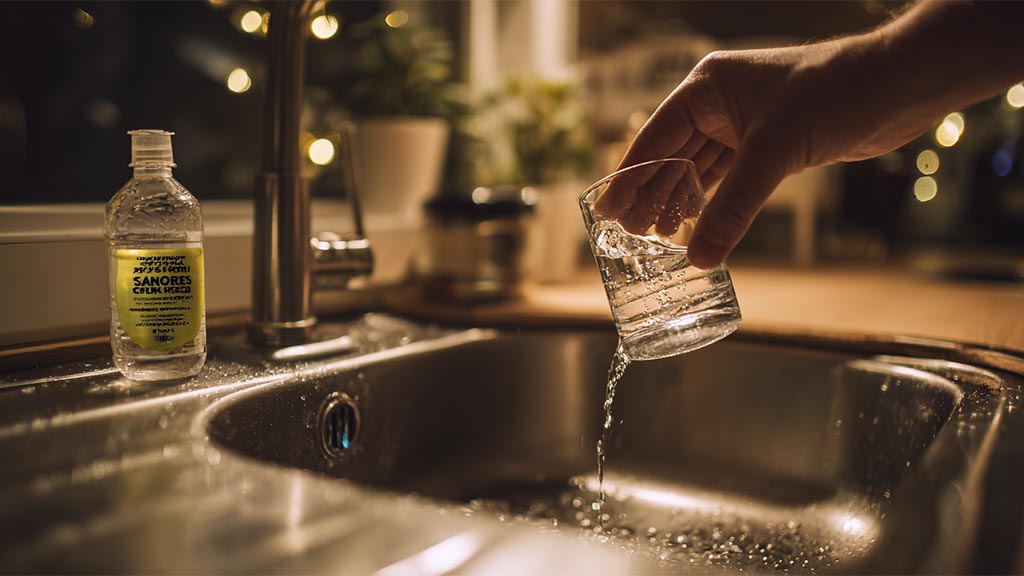
- Pour approximately half a glass — around 100 to 150 ml — directly into the drain
- Leave it completely undisturbed overnight, ideally for six to eight hours
- The following morning, flush with warm water for a minute or two
No fizzing, no fumes, no drama. While you sleep, the enzymatic solution flows through the pipe, clings to the inner walls, and quietly digests the organic matter responsible for the blockage and the odour.
- → Nationwide Listeria Recall in France: What You Need to Know About Contaminated Pâtés and Cold Meats in 2026
- → The Unexpected Household Hack That Keeps Wet Floors and Entryways Clean in 2026
- → The Hair Transformation Women Over 50 Are Talking About in 2026: What Really Works for Thinning Hair
- → Marseille’s Mistral District in Crisis: Arrests, Secrets, and a Growing Mystery in 2026
- → Massive 35-Meter Waves in the Pacific: What Scientists Are Discovering in 2026
- → Why You’re Receiving More Spam Calls in 2026: The Hidden Reasons and How to Stop Them
- → The Express Chignon: A Quick and Elegant Hairstyle for Busy Women in 2026
The Science Behind It
Enzymes are proteins that accelerate specific chemical reactions. In this context, they target the organic components of drain blockages — fat, food residue, hair, and soap film — breaking them down into smaller, water-soluble particles that wash away easily with the next flush.
This biological approach avoids the central problem with aggressive chemical gel unblockers, which can corrode metal pipes, weaken joints, and produce fumes that accumulate in enclosed spaces. Enzymatic cleaners work more slowly, but they work more thoroughly when used with any regularity, and they are considerably gentler on both pipework and the people using them. Most are water-based, biodegradable, and safe for septic tank systems.
A Real-World Example
One homeowner in Lyon had battled a persistent, unpleasant odour from her bathroom sink for several months. She had tried boiling water, repeated vinegar treatments, and had even dismantled the siphon herself on one particularly determined occasion. Nothing produced lasting results.
Two consecutive evenings of the half-glass enzymatic method, applied before bed, eliminated the smell entirely. The drain returned to what she described as its “forgotten state” — silent, invisible, and completely functional.
How to Use the Half-Glass Method Correctly
What to Buy
Look for products labelled as enzymatic, biological, or “bio” drain cleaner — specifically those described as containing bacteria and enzymes for organic waste breakdown. These are distinct from corrosive chemical gel unblockers, which work through an entirely different and considerably harsher mechanism.
Step-by-Step Application
- Remove visible debris from the plug or drain cover before starting
- Shake the bottle gently to ensure the contents are evenly mixed
- Pour approximately half a glass (100–150 ml) directly into the drain — no need to dilute with water
- Leave overnight without running hot water through that drain — six to eight hours is ideal
- Flush the following morning with warm, not boiling, water to clear the broken-down residue
- Repeat on consecutive nights for two or three evenings if the drain is significantly sluggish
For ongoing maintenance and prevention, a single monthly application is generally sufficient to keep pipes clear, odour-free, and flowing freely.
Common Mistakes That Undermine the Results
Expecting Instant Results on Neglected Pipes
Enzymatic cleaners work progressively, not instantaneously. A drain that has been accumulating buildup for years will not be fully restored after a single overnight treatment. If water is already standing completely still in the sink — indicating a total blockage rather than a partial one — mechanical intervention is needed first. A plunger, drain snake, or professional inspection should precede the enzymatic treatment in these cases. The biological method then maintains the clear pipe rather than fighting to establish one.
Mixing Products
This is the mistake that renders enzymatic treatment completely ineffective. Chlorine-based products, caustic soda, and acid gels neutralise the beneficial bacteria and enzymes on contact. If you have recently used a chemical unblocking product, allow several days and flush thoroughly with water before introducing an enzymatic cleaner. Choose one approach and commit to it — the two methods are fundamentally incompatible.
Impatience
The temptation to add more product when results are not immediate is understandable but counterproductive. Enzymatic cleaners require time and an undisturbed environment to work effectively. Flushing with water too soon or adding additional products mid-treatment interrupts the process before it has had the opportunity to work.
Where Vinegar and Baking Soda Still Belong
Abandoning the enzymatic method in favour of the vinegar and baking soda combination for deep drain cleaning does not mean those household staples have no value — far from it. They remain genuinely effective for:
- Dissolving limescale deposits around taps and fixtures
- Descaling kettles and coffee machines
- Cleaning tile grout and grouting joints
- Addressing surface-level odours near the drain opening
Their limitations lie specifically in tackling dense, deep, organic blockages within pipework — not in cleaning applications generally.
Building a Simple Monthly Drain Maintenance Habit
The most compelling aspect of the half-glass enzymatic method is how little it demands. A single monthly application takes approximately thirty seconds and requires no scrubbing, no unpleasant fumes, and no anxiety about damaging the pipework.
As one building caretaker put it: “I pour half a glass, lock the door, go home. The pipes do the rest while I’m eating dinner.”
That kind of low-effort consistency is what separates households that encounter drain emergencies from those that simply never do. The occasional Sunday morning spent waiting for a plumber is almost always the consequence of deferred maintenance — problems that would have been prevented entirely by a modest monthly habit.
Conclusion
Slow drains and persistent sink odours are among the most common and most avoidable household problems. For years, the default response has been either ineffective home remedies or aggressive chemical products that risk damaging pipework while delivering short-lived results.
The enzymatic half-glass method offers a third option — one grounded in biology rather than brute force, and realistic enough to actually maintain as a monthly routine. It requires no special skills, no unpleasant chemicals, and no more than a few minutes of attention. In return, it delivers pipes that function quietly and reliably, and a home that smells as clean as it looks.
The next time your drain begins to slow, resist the instinct to reach for the vinegar. Half a glass poured before bed, and a little patience, will accomplish considerably more.
Frequently Asked Questions
Is the enzymatic method safe for all pipe materials? Most enzymatic drain cleaners are safe for use with PVC, copper, and older metal pipes, as well as with septic tank systems. They are considerably gentler on pipework than caustic chemical products. Always check the specific product label to confirm compatibility, but biological cleaners are broadly recognised as the low-risk option for routine maintenance.
What should I do if the drain is already completely blocked? A total blockage — where water is not moving at all — requires mechanical intervention first. Use a plunger, drain snake, or contact a plumber to physically clear the obstruction. Once water flow is restored, introduce the enzymatic method to clean the pipe interior and prevent the blockage from rebuilding.
Is vinegar actually harmful to drains? In small quantities, vinegar is not damaging to pipes, and it can be useful for surface odours and minor limescale near the drain entrance. Its limitation is effectiveness rather than safety — it lacks the potency to address thick, deep organic blockages, and should not be relied upon as a substitute for a proper maintenance routine.
How quickly does enzymatic cleaner produce noticeable results? For mild blockages or odour issues, improvement is often apparent after the very first overnight treatment. For pipes with significant accumulated buildup, two to three consecutive nightly applications are typically required before drainage and odour return to normal.
Can I use boiling water alongside enzymatic cleaner? It is better avoided. Boiling water can stress certain plastic pipe materials and, more importantly, it can kill the beneficial bacteria within the enzymatic solution before they have had time to work. Warm water is sufficient for the morning flush and preserves the effectiveness of the biological organisms.




Leave a comment