
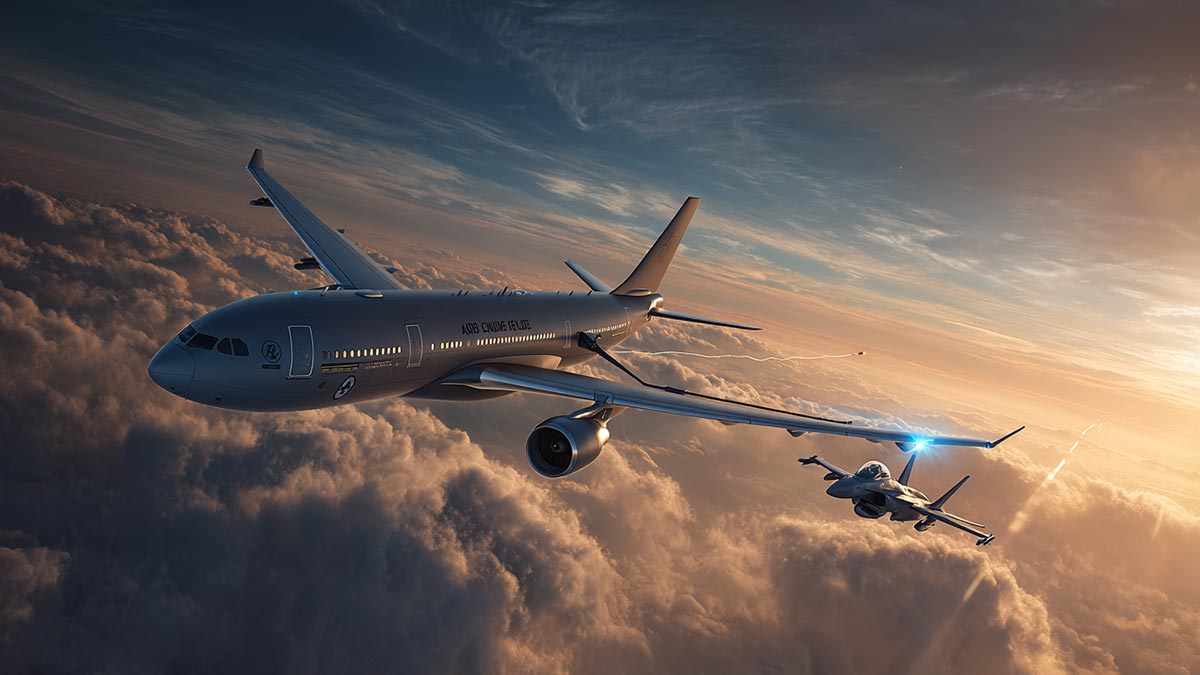
A defining moment in modern aviation history unfolded on February 4, 2026, when the Republic of Singapore Air Force (RSAF) became the first military force in the world to operationally deploy a completely autonomous air-to-air refuelling fleet. Powered by Airbus’ advanced A3R (Automatic Air-to-Air Refuelling) system, this achievement has fundamentally shifted the competitive landscape — leaving Boeing’s KC-46A Pegasus tanker program trailing in its wake.
As air forces around the world watched closely, Singapore’s willingness to embrace this next-generation technology has cemented its standing as a true pioneer in military aviation.
What Is the Airbus A3R System?
The Technology Behind the Breakthrough
The Airbus A3R system is the product of years of rigorous research, development, and real-world testing. At its core, it replaces traditional manual refuelling procedures with a fully automated process driven by advanced sensors, precision control algorithms, and intelligent coupling mechanisms.
Unlike conventional refuelling — which demands constant input and coordination from both tanker and receiver crews — the A3R system handles the entire sequence autonomously. This includes the initial approach and rendezvous, the physical coupling between aircraft, fuel transfer, and final disengagement, all without requiring direct human intervention.
Certified and Combat-Ready
Before being cleared for frontline service, the A3R system underwent an exhaustive certification process to validate its reliability and safety. This rigorous vetting has given the RSAF — and the broader defense community — the confidence needed to integrate autonomous refuelling into live operational missions.
Singapore’s Historic Deployment — A Milestone for Global Aviation
Why the RSAF Led the Way
Singapore’s decision to be the launch customer for this technology reflects the RSAF’s long-standing commitment to staying at the cutting edge of military capability. Rather than waiting for the technology to become mainstream, the RSAF worked directly with Airbus in a deep collaborative effort involving intensive crew training, careful operational planning, and joint system integration.
The result is a fully operational autonomous refuelling fleet — a first that no other air force in the world can currently claim.
What This Means Beyond Singapore
The RSAF’s successful deployment sends a powerful signal to defense establishments worldwide. As other air forces study the performance outcomes of this program, interest in autonomous refuelling solutions is expected to accelerate rapidly, triggering both procurement shifts and intensified research and development efforts across the industry.
Airbus vs. Boeing: The Aerial Refuelling Race Heats Up
A Direct Comparison
The contrast between Airbus’ A3R and Boeing’s KC-46A Pegasus has become one of the most closely watched rivalries in the defense sector:
| Feature | Airbus A3R | Boeing KC-46A |
|---|---|---|
| Refuelling Capability | Fully Autonomous | Partially Automated |
| Certification Status | Certified for Frontline Use | Ongoing Certification Challenges |
| Operational Efficiency | Higher throughput, reduced crew workload | Limited gains, crew-intensive operations |
| Safety Record | Proven through extensive testing | Persistent safety concerns reported |
Boeing Under Pressure
While the KC-46A was positioned as a next-generation tanker upon its introduction, it has faced a series of persistent technical setbacks and unresolved certification issues. In contrast, the A3R system’s proven autonomy and operational track record have attracted significant attention from air forces actively evaluating tanker acquisitions. Airbus has effectively seized the initiative, placing Boeing on the defensive in a market where reliable performance is non-negotiable.
What This Means for the Broader Aviation Industry
Transforming Military Aerial Logistics
The introduction of fully autonomous in-flight refuelling stands to reshape how air forces plan and execute missions. By dramatically reducing crew workload, increasing throughput, and removing human error from the refuelling equation, the A3R system offers a compelling operational advantage. Mission planners gain greater flexibility, and sortie rates can potentially increase — all while improving overall crew safety.
A Gateway to Broader Autonomous Aviation
The implications of this breakthrough extend well beyond military tanker operations. The success of the A3R system may accelerate adoption of autonomous technologies in adjacent areas of aviation, including flight management, navigation systems, and formation control. Both military and commercial aviation stakeholders are likely to draw lessons from Singapore’s experience as they chart their own paths toward greater automation.
Commercial Aviation on the Horizon
As the technology continues to mature and operational data accumulates, some industry analysts believe that autonomous refuelling concepts could eventually be adapted for commercial aviation — unlocking potential efficiency gains, fuel savings, and expanded route capabilities for civilian operators.
The Future of Autonomous In-Flight Refuelling
The RSAF’s operational deployment of the A3R system is not just a milestone — it’s a turning point. What was once considered experimental is now a frontline reality, and the bar for what air forces should expect from their tanker fleets has been permanently raised.
As global demand for autonomous aerial capabilities grows, Airbus is well-positioned to expand its customer base significantly. Meanwhile, competitors face mounting pressure to close the capability gap — or risk falling further behind in one of defense aviation’s most strategically critical segments.
The era of fully autonomous in-flight refuelling has arrived, and the world is only beginning to understand the full scope of what that means.
Conclusion
Airbus and the Republic of Singapore Air Force have jointly written a new chapter in aviation history. The February 2026 deployment of the world’s first fully autonomous in-flight refuelling fleet — built around the A3R system — marks a genuine technological leap forward, outpacing rivals and establishing a new global standard for aerial tanker operations. For air forces evaluating their next generation of capabilities, for defense industry observers tracking the Airbus-Boeing rivalry, and for aviation enthusiasts following the march of autonomous technology, this development is one that will resonate for years to come. Singapore didn’t just adopt new technology — it showed the world what the future of air power looks like.
Frequently Asked Questions (FAQs)
Q1: What is the Airbus A3R system? The A3R (Automatic Air-to-Air Refuelling) system is Airbus’ fully autonomous in-flight refuelling technology. It uses advanced sensors, algorithms, and precision controls to manage the entire refuelling sequence — from approach and coupling to fuel transfer and disengagement — without requiring direct crew input.
Q2: When did the RSAF deploy the A3R system? The Republic of Singapore Air Force officially deployed the world’s first fully autonomous in-flight refuelling fleet on February 4, 2026.
Q3: How does the A3R system differ from traditional refuelling methods? Conventional in-flight refuelling relies heavily on crew coordination and manual control. The A3R system automates the entire process, significantly reducing crew workload, minimizing human error, and improving operational efficiency.
Q4: How does the Airbus A3R compare to Boeing’s KC-46A Pegasus? The A3R is fully autonomous and has been certified for frontline operational use, while the KC-46A remains only partially automated and continues to face unresolved certification and safety challenges.
- → Nationwide Listeria Recall in France: What You Need to Know About Contaminated Pâtés and Cold Meats in 2026
- → The Unexpected Household Hack That Keeps Wet Floors and Entryways Clean in 2026
- → The Hair Transformation Women Over 50 Are Talking About in 2026: What Really Works for Thinning Hair
- → Marseille’s Mistral District in Crisis: Arrests, Secrets, and a Growing Mystery in 2026
- → Massive 35-Meter Waves in the Pacific: What Scientists Are Discovering in 2026
- → Why You’re Receiving More Spam Calls in 2026: The Hidden Reasons and How to Stop Them
- → The Express Chignon: A Quick and Elegant Hairstyle for Busy Women in 2026
Q5: Why is Singapore’s deployment historically significant? The RSAF became the first air force in the world to integrate a fully autonomous in-flight refuelling system into active frontline operations — a landmark that no other military had achieved before.
Q6: Could this technology ever be used in commercial aviation? As the A3R system matures and generates more operational data, industry experts believe autonomous refuelling concepts could eventually be adapted for civilian aircraft, offering efficiency and cost benefits to commercial operators.
Q7: What enabled the RSAF’s successful deployment? The deployment succeeded through a combination of meticulous planning, extensive aircrew training, and close technical collaboration between Airbus engineers and Singapore’s military aviation specialists.
Q8: How will this affect the global defense aviation market? Airbus’ lead in autonomous refuelling technology will place significant competitive pressure on Boeing and other rivals, likely driving increased investment in next-generation tanker development across the industry.



Leave a comment