

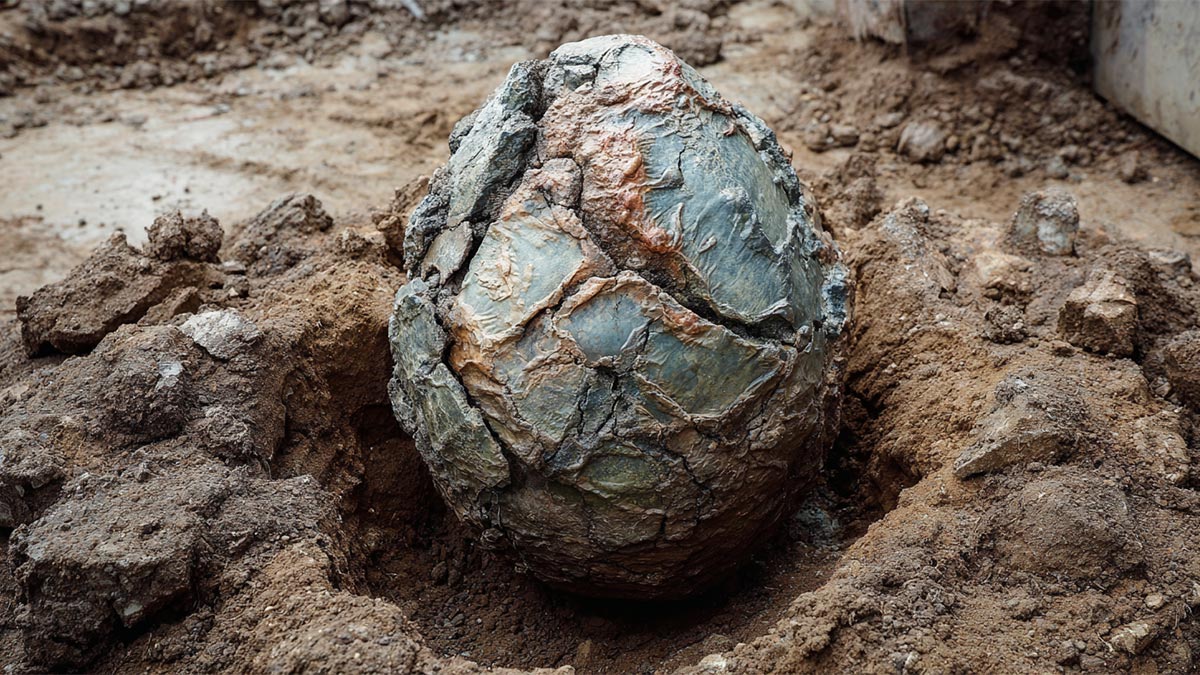
A remarkable discovery in southern France has revealed one of Europe’s richest dinosaur nesting grounds, with hundreds of fossilized eggs from multiple species preserved for over 70 million years. This finding offers rare insight into how dinosaurs reproduced and lived during the final chapter of their existence.
A Challenging Excavation That Led to a Historic Discovery
The excavation was carried out by a team from the Musée-Parc des Dinosaures near the town of Mèze, located between Béziers and Montpellier.
What began in October as a routine dig soon turned into a demanding mission:
- Persistent rain turned the ground into thick mud
- Excavation had to stop repeatedly
- Researchers waited days for clay layers to dry before continuing
Despite these setbacks, the team pushed through until March, uncertain about what lay beneath the surface.
The Breakthrough: A Fossil-Rich Layer Emerges
Once conditions improved, scientists uncovered a dense horizontal rock layer packed with fossil fragments. As excavation progressed:
- The concentration of fossils exceeded all previous findings at the site
- The layer extended beyond the excavation trench into nearby hills
- It revealed an extraordinary accumulation of dinosaur remains
This marked the beginning of a truly significant paleontological discovery.
Over 100 Dinosaur Eggs Preserved for Millions of Years
The most striking find was a fossilized layer containing more than 100 dinosaur eggs, with many more likely still buried.
Dating the Site
- Estimated age: 70–72 million years
- Geological period: Late Cretaceous Period
- Timeline: Just before the mass extinction of non-avian dinosaurs
At that time, the region was a lush tropical floodplain, filled with rivers, wetlands, and dense vegetation—ideal conditions for nesting.
How These Eggs Survived So Long
The preservation of the eggs follows patterns seen in modern reptiles:
Nesting Behavior
- Dinosaurs likely dug shallow nests
- Eggs were laid in clusters
- Covered with vegetation, sand, or mud
As plant material decomposed, it generated heat—naturally incubating the eggs.
Role of Flooding
- Repeated floods rapidly buried the nests
- This prevented shells from breaking or eroding
- Clay-rich sediments sealed the eggs for millions of years
Interestingly, the same sticky clay that slowed researchers down is what protected the eggs for 70 million years.
Evidence of Multiple Dinosaur Species
Researchers also found different types of eggs within the same site, suggesting multiple dinosaur species used this area.
Possible species include:
- Armored herbivores like Ankylosaur
- Smaller carnivorous dinosaurs (theropods)
This indicates that the site was likely a shared nesting ground, revisited by different species over time.
👉 Scientists believe the location offered:
- → Nationwide Listeria Recall in France: What You Need to Know About Contaminated Pâtés and Cold Meats in 2026
- → The Unexpected Household Hack That Keeps Wet Floors and Entryways Clean in 2026
- → The Hair Transformation Women Over 50 Are Talking About in 2026: What Really Works for Thinning Hair
- → Marseille’s Mistral District in Crisis: Arrests, Secrets, and a Growing Mystery in 2026
- → Massive 35-Meter Waves in the Pacific: What Scientists Are Discovering in 2026
- → Why You’re Receiving More Spam Calls in 2026: The Hidden Reasons and How to Stop Them
- → The Express Chignon: A Quick and Elegant Hairstyle for Busy Women in 2026
- Favorable soil conditions
- Abundant vegetation
- Relative safety from predators
Protecting the Site From Fossil Theft
The importance of this location was first recognized in 1996 by site director Alain Cabot.
However, early discoveries attracted private collectors, leading to fossil theft. To prevent further loss:
- A museum was built directly on-site
- Excavations are now protected and monitored
- Visitors can observe ongoing research in real time
Cabot emphasized that preserving the site ensures both scientific integrity and public education.
Previous Discoveries Add to the Site’s Importance
This site has already produced notable findings:
1998 Discovery
- One of the smallest known dinosaur eggs (7 cm long)
- Identified as Prismatoolithus caboti
- Likely belonged to a small carnivorous dinosaur
1999 Discovery
- A new species of ankylosaur (~3 meters long)
- Fossil included preserved skin and armor plates
- Found alongside remains of turtles, crocodiles, and fish
These discoveries confirm the site as a rich and diverse prehistoric ecosystem.
Why This Discovery Matters in 2026
As of 2026, this site continues to provide valuable insights into:
- Dinosaur reproduction and nesting behavior
- Species diversity in the late Cretaceous
- Environmental conditions before the mass extinction
Eggshell structures, in particular, help scientists track evolutionary changes and population patterns over time.
Conclusion
The discovery of hundreds of dinosaur eggs in Mèze represents a major milestone in paleontology. Preserved for over 70 million years, these fossils offer a rare glimpse into how dinosaurs lived, reproduced, and interacted within their environment.
Beyond its scientific value, the site highlights the importance of protecting natural heritage from exploitation. As research continues into 2026, this extraordinary nesting ground will likely uncover even more secrets about the final days of the dinosaurs.
FAQs
1. How old are the dinosaur eggs found in France?
They date back approximately 70–72 million years to the late Cretaceous period.
2. How many eggs were discovered?
Over 100 eggs have already been uncovered, with more likely still buried.
3. Why are the eggs so well preserved?
Rapid burial by floods and protective clay sediments prevented damage over millions of years.
4. Did multiple dinosaur species use this site?
Yes, evidence suggests different species returned to the same area to lay eggs.
5. Can the public visit the site?
Yes, the museum allows visitors to observe excavations and learn about ongoing research.




Leave a comment