

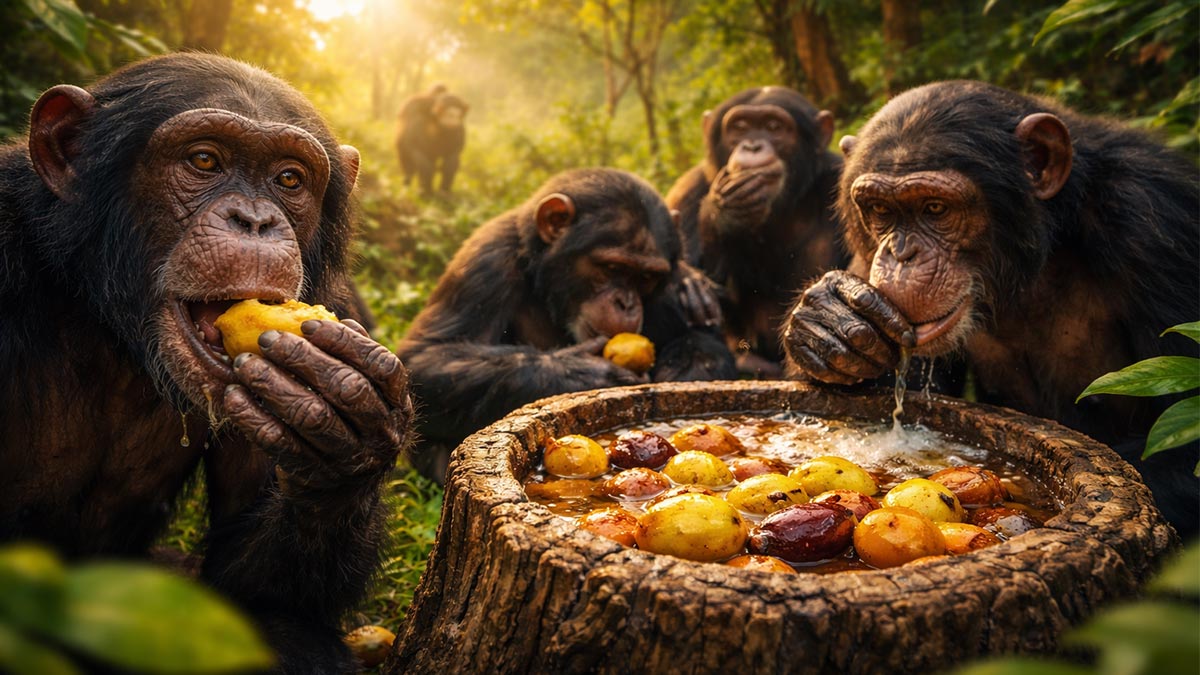
A surprising scientific observation has captured global attention: wild chimpanzees consuming naturally fermented fruit that contains alcohol. While it may sound unusual, this behavior is not random or rare. Researchers studying chimpanzee populations across parts of Africa have documented consistent patterns of alcohol intake, offering new insight into both animal behavior and the evolutionary roots of human habits.
As of 2026, scientists increasingly believe that the tendency to seek mild intoxication may not be uniquely human. Instead, it could be deeply embedded in our evolutionary history, shared with our closest relatives in the animal kingdom.
How Chimpanzees Consume Alcohol in the Wild
Chimpanzees do not brew or store alcohol the way humans do. Instead, they obtain it naturally through fermented fruits. When fruits ripen and begin to decompose, natural sugars convert into ethanol, creating a mild alcoholic content.
Field researchers have observed chimpanzees regularly consuming these fruits in regions such as Tanzania and Uganda. On average, their intake is comparable to about half a standard beer per day when adjusted for their body size. For a chimpanzee weighing around 45 kilograms, this represents a meaningful amount of alcohol.
Social Drinking Patterns Among Chimps
One of the most fascinating aspects of this discovery is how chimpanzees consume alcohol. Rather than drinking alone, they tend to gather in groups, sharing fermented fruit in a social setting.
This mirrors human social drinking behavior, where alcohol is often associated with bonding and group interaction. Importantly, chimpanzees appear to regulate their intake. Researchers rarely observe them becoming heavily intoxicated or losing coordination, suggesting a natural balance in their consumption habits.
Evolutionary Roots of Alcohol Consumption
The presence of alcohol-seeking behavior in chimpanzees points to an evolutionary explanation. Scientists believe that early primates may have developed the ability to detect and metabolize ethanol as a way to identify energy-rich, ripe fruit.
Over time, this adaptation may have evolved into a broader attraction to mildly intoxicating substances. The fact that chimpanzees and humans share this trait suggests that the desire for altered mental states could date back millions of years.
Alcohol Use Across the Animal Kingdom
Chimpanzees are not alone in consuming alcohol. Various animal species have been observed interacting with fermented food sources.
Fruit flies are known to actively seek out fermenting fruit
Elephants have been reported consuming fermented beverages in certain environments
Reindeer have been observed eating naturally occurring psychoactive substances
- → Nationwide Listeria Recall in France: What You Need to Know About Contaminated Pâtés and Cold Meats in 2026
- → The Unexpected Household Hack That Keeps Wet Floors and Entryways Clean in 2026
- → The Hair Transformation Women Over 50 Are Talking About in 2026: What Really Works for Thinning Hair
- → Marseille’s Mistral District in Crisis: Arrests, Secrets, and a Growing Mystery in 2026
- → Massive 35-Meter Waves in the Pacific: What Scientists Are Discovering in 2026
- → Why You’re Receiving More Spam Calls in 2026: The Hidden Reasons and How to Stop Them
- → The Express Chignon: A Quick and Elegant Hairstyle for Busy Women in 2026
These examples reinforce the idea that the consumption of intoxicating substances is not exclusive to humans but part of a broader biological pattern.
What This Means for Understanding Human Behavior
This discovery challenges the long-standing belief that alcohol consumption is purely a cultural or social construct. Instead, it suggests that biological and evolutionary factors play a significant role.
Understanding this connection may help reshape how society views substance use and addiction. If the urge to consume intoxicants has deep evolutionary origins, it becomes clear that addressing problematic behavior requires more than simple moral judgment. It calls for a more scientific and compassionate approach.
Lessons from Chimpanzee Drinking Habits
Chimpanzees offer an interesting contrast to human patterns of alcohol use. Despite regular exposure to alcohol through fermented fruit, they do not display signs of dependency or harmful overconsumption.
Their behavior highlights a few key points
They consume alcohol in moderation
Their drinking is often social rather than isolated
They do not exhibit compulsive or destructive patterns
These observations suggest that controlled and balanced consumption may be rooted in natural behavior, offering a potential model for healthier human habits.
Potential Benefits Observed in Chimps
Researchers have noted several possible advantages linked to this behavior
Social bonding is strengthened when chimpanzees gather to share fermented fruit
Mild intoxication may help reduce stress after daily activities
Low levels of alcohol could support cognitive stimulation, though more research is needed
While these effects are still being studied, they provide an interesting perspective on how alcohol interacts with biological systems.
Understanding the Scale of Consumption
To better understand what “half a beer” means for a chimpanzee, researchers analyzed the alcohol content and volume of fermented fruit.
The ethanol concentration is estimated at around 3 to 4 percent, similar to light beer
The quantity consumed equates to roughly 150 to 180 milliliters
For humans, this would be comparable to about one standard drink per day when adjusted for body weight
This shows that chimpanzees are not consuming trivial amounts but are still able to maintain control.
Broader Implications for Addiction Research
The findings may have important implications for understanding addiction. If alcohol-seeking behavior is biologically ingrained, it suggests that addiction may arise when natural tendencies become dysregulated.
Studying how chimpanzees maintain balance could help researchers develop better prevention and treatment strategies for humans. It may also encourage a shift toward approaches that consider both biological and environmental factors.
Conclusion
The observation of alcohol consumption among wild chimpanzees offers a powerful reminder that human behavior is deeply connected to our evolutionary past. What might seem like a uniquely human habit is, in fact, shared with other species and rooted in biology.
Rather than viewing alcohol use solely through a social or cultural lens, this discovery highlights the importance of understanding its origins. By learning from our closest relatives, we may gain valuable insights into maintaining balance, preventing harm, and developing more effective approaches to managing substance use in modern society.
FAQs
Do chimpanzees actually get drunk
Researchers have found that chimpanzees rarely consume enough alcohol to become heavily intoxicated
Why do chimpanzees eat fermented fruit
They are naturally attracted to ripe fruit, which sometimes contains alcohol due to fermentation
Is alcohol consumption common in animals
Yes, several species consume naturally fermented foods when available
What can humans learn from chimpanzees
Chimpanzees demonstrate moderation and social consumption, which may offer insights into healthier habits
Does this discovery explain human addiction
It suggests that alcohol use has evolutionary roots, but addiction is influenced by many additional factors



Leave a comment