

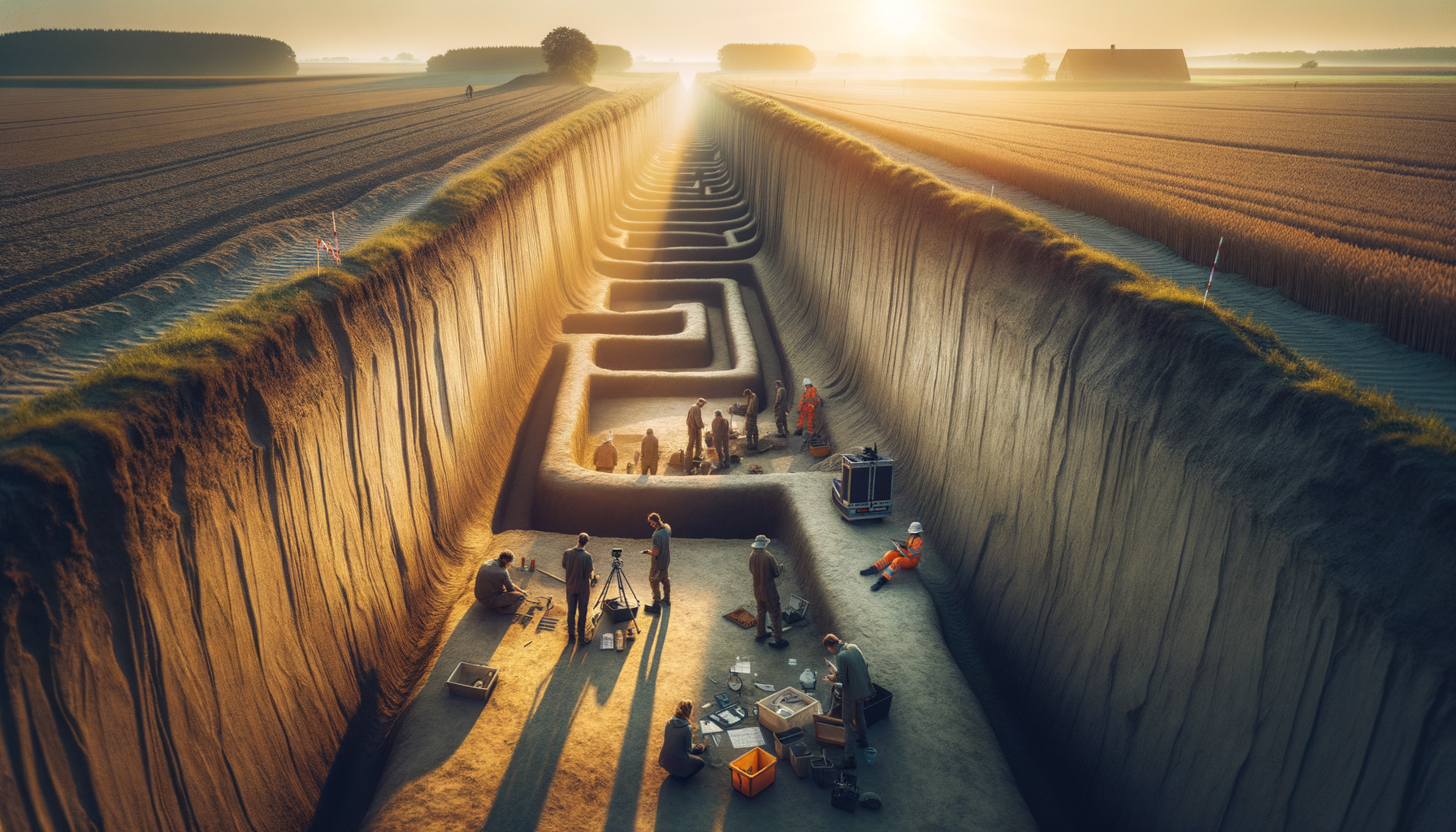
A Groundbreaking Discovery Beneath German Soil
In what archaeologists are calling one of the most remarkable finds of the decade, beneath a hill in central Germany, researchers have uncovered a striking overlap of eras: medieval tunnels carved directly into a prehistoric burial site. The discovery, announced in late January 2026 by the State Office for Heritage Management and Archaeology of Saxony-Anhalt (LDA), reveals how human communities across millennia have interacted with—and reinterpreted—the same sacred landscapes.
The buried tunnel measures about two feet wide and four feet high, and was likely constructed anywhere between 800 to 1,100 years ago near the town of Reinstedt. What makes this discovery extraordinary is that the medieval Erdstall was dug directly into a prehistoric burial site, some as old as 6,000 years, featuring Neolithic ditches, burial tombs, and even a Bronze Age burial mound.
The Site’s Ancient Origins: The Baalberge Culture
The discovery near Reinstedt was made in preparation for the construction of wind turbines, when LDA archaeologists found a trapezoidal ditch associated with the Baalberge people—a late Neolithic “culture” that emerged in central Germany between 4000 and 3150 BC.
The archaeological landscape at Dornberg hill proved to be exceptionally rich. Findings include a Neolithic trapezoidal ditch from the Baalberg culture, poorly preserved burial remains from the late Neolithic period, and traces of a possible Bronze Age burial mound. Together, these discoveries demonstrate that the site was repeatedly used for ritual and funerary purposes over thousands of years.
These Neolithic communities invested serious labour in their burial architecture. Ditches encircled certain spots, marking them as special. Mounds raised over the dead created visible landmarks on the horizon. Such monuments would have stood for generations, signalling ancestral presence and control over the land.
What Is an Erdstall? Europe’s Enigmatic Medieval Tunnels
An erdstall is a type of tunnel that is found throughout Europe, mainly in the south-eastern German state of Bavaria and Austria. Erdstalls are thought to have been created during the Middle Ages, though some have claimed that these tunnels date to the Stone Age. At the moment, nobody is entirely certain as to why such features were made in the first place.
The term itself provides little clarity. The word ‘erdstall’ is derived from the German language, and may be roughly translated as ‘earth stable’ or ‘mining tunnel.’ At present, around 2,000 erdstalls are known to exist in Europe. The bulk of these may be found in the German state of Bavaria, where at least 700 of these tunnel networks are estimated to exist. In neighbouring Austria, about 500 more erdstalls may be found. Such underground passages have also been found in countries such as the UK and France.
Because the tunnels are normally extremely narrow, some legends cast erdstalls as home to dwarfs, goblins, and other diminutive mythical creatures, which is why they are known as Schratzlloch (goblin holes) or Zwergloch (dwarf holes) in some regions.
Inside the Reinstedt Erdstall: Physical Characteristics
Removal of soil in the northern section revealed a tight passage curving northwest. The corridor measured between roughly one meter and 1.25 meters in height and only 50 to 70 centimeters in width. Parts of the passage feature a pointed gable-shaped ceiling, while the entrance area includes a carved step and a niche in the wall.
The discovery itself unfolded like a mystery. “This led to the assumption that it could be a burial—but the fact that the finding then turned out to be something completely different, that it was in fact an erdstall, was an unexpected surprise that caused fascination and excitement among the team,” said archaeologist Jochen Fahr of the State Office for Monument Preservation and Archaeology.
Within the southern stretch of the Baalberge ditch, archaeologists noticed an elongated oval pit about two meters long and up to 75 centimeters wide. A heavy stone slab rested near one end, which at first suggested a grave feature.
Artifacts Found Within the Tunnel
Among the most intriguing finds inside the tunnel were a horseshoe, fragments of late medieval ceramic vessels, a fox skeleton, and numerous small mammal bones. At the lowest level, archaeologists uncovered a thin charcoal layer. Because there was no reddening of the surrounding soil—only slight hardening—the team believes the fire burned briefly rather than continuously.
Archaeologists found pottery that dates to about the 13th or 14th century in the chamber. Radiocarbon dating confirmed the medieval attribution while also refining the chronology. Multiple samples suggested the tunnel’s construction occurred between 1280-1320 CE, a period documented as economically active in the region.
A cluster of large stones stacked at the narrowest part of the entrance suggests that the tunnel may have been deliberately sealed, possibly after its final use.
Why Would Medieval People Tunnel Into an Ancient Burial Site?
Perhaps the most fascinating question raised by this discovery is why medieval builders chose to excavate their tunnel into a visible prehistoric monument. Researchers propose two main explanations. The first is practical. The visible ditches may have signaled that the site had once been used for defensive purposes. Medieval inhabitants could have interpreted the area as a place associated with protection and therefore chosen it as a natural refuge during unstable times.
The second explanation is more spiritual in nature. Because of its “pagan” graves, the site may have been avoided by the broader population. That avoidance, paradoxically, could have made it an ideal hiding place.
A prehistoric burial site could have been seen as a “pagan grave” and treated with caution by local people. If so, that social unease might have made it an ideal spot for a medieval hiding place—somewhere less likely to be disturbed.
The Broader Mystery of Erdstalls
Erdstalls are of unknown origin but are believed to date from the Middle Ages. A variety of purposes have been theorized, including that they were used as escape routes or hiding places, but the most prominent theory is that they served a religious or spiritual purpose.
The tunnels-as-defense explanation is problematic not just because the erdstall passages are so claustrophobic, but because they only have one entrance, making them little more than long earthen coffins for anyone trying to hide or escape through them. Even if they were used as temporary shelter, the ability to cut off the air supply to the entire system via the single entrance makes the proposition extremely dangerous.
- → Nationwide Listeria Recall in France: What You Need to Know About Contaminated Pâtés and Cold Meats in 2026
- → The Unexpected Household Hack That Keeps Wet Floors and Entryways Clean in 2026
- → The Hair Transformation Women Over 50 Are Talking About in 2026: What Really Works for Thinning Hair
- → Marseille’s Mistral District in Crisis: Arrests, Secrets, and a Growing Mystery in 2026
- → Massive 35-Meter Waves in the Pacific: What Scientists Are Discovering in 2026
- → Why You’re Receiving More Spam Calls in 2026: The Hidden Reasons and How to Stop Them
- → The Express Chignon: A Quick and Elegant Hairstyle for Busy Women in 2026
Other interpretations insist on their possible use for initiation rituals, as places of spiritual retreat, or simply as temporary hideouts for people and valuable goods during periods of instability, although the absence of a second exit complicates this last explanation. Their location, often in the basements of old farmhouses, near churches, cemeteries, or in remote forests, adds further layers of mystery to their original purpose.
Archaeology and Renewable Energy: An Unexpected Partnership
The discovery of the medieval tunnel system within the prehistoric burial mound at Reinstedt is not an isolated incident. In fact, it is part of a growing trend of archaeological discoveries that have been spurred by the development of renewable energy projects, such as wind farms, across Europe. As governments and companies seek to expand their renewable energy infrastructure, the need for comprehensive site surveys and excavations has become increasingly important. These surveys often uncover a wealth of previously unknown archaeological treasures.
The latest surveys were triggered by plans to install wind turbines. German law requires “preventive archaeology” in such cases, so teams from the State Office for Heritage Management and Archaeology of Saxony-Anhalt moved in with geophysical instruments and excavation equipment.
Implications for Understanding Medieval Society
The find challenges assumptions about medieval “vandalism” of ancient sites. While some desecration was undoubtedly deliberate and motivated by religious or superstitious beliefs, economic utility often drove modifications. Medieval people were not simply destroying the past—they were recycling it.
The erdstall of Reinstedt, by being inserted into such a clearly defined and ancient archaeological context, provides a singular perspective. It is not an isolated tunnel in a forest or beneath a farmhouse, but a calculated intrusion into a space already sacralized thousands of years earlier. This deliberate reuse of a monument from the remote past suggests that, already in the Middle Ages, the place carried a significant charge, whether as a practical landmark in the terrain or as a liminal territory, outside everyday spaces.
Key Takeaways
- Location: The tunnel was discovered at Dornberg hill near Reinstedt in Saxony-Anhalt, Germany, during pre-construction surveys for wind turbines.
- Age: The Neolithic burial site dates to the 4th millennium BCE (approximately 6,000 years old), while the medieval erdstall was constructed between 1280-1320 CE.
- Dimensions: The tunnel measures approximately 1-1.25 meters in height and 50-70 centimeters in width, featuring a distinctive gabled ceiling.
- Artifacts: Medieval pottery fragments, a horseshoe, a fox skeleton, and small mammal bones were recovered from within the passage.
- Significance: This is the first known example of an erdstall carved directly into a well-dated prehistoric burial monument, offering unique insights into how medieval communities interacted with ancient landscapes.
- Ongoing Research: Analysis of soil layers and artifacts continues to refine understanding of the tunnel’s construction and use phases.
The discovery highlights how, across centuries, societies have reused and reinterpreted landscapes shaped by their predecessors. As renewable energy development continues across Europe, such finds underscore the critical importance of archaeological surveys in uncovering and preserving humanity’s layered heritage before construction begins.




Leave a comment