

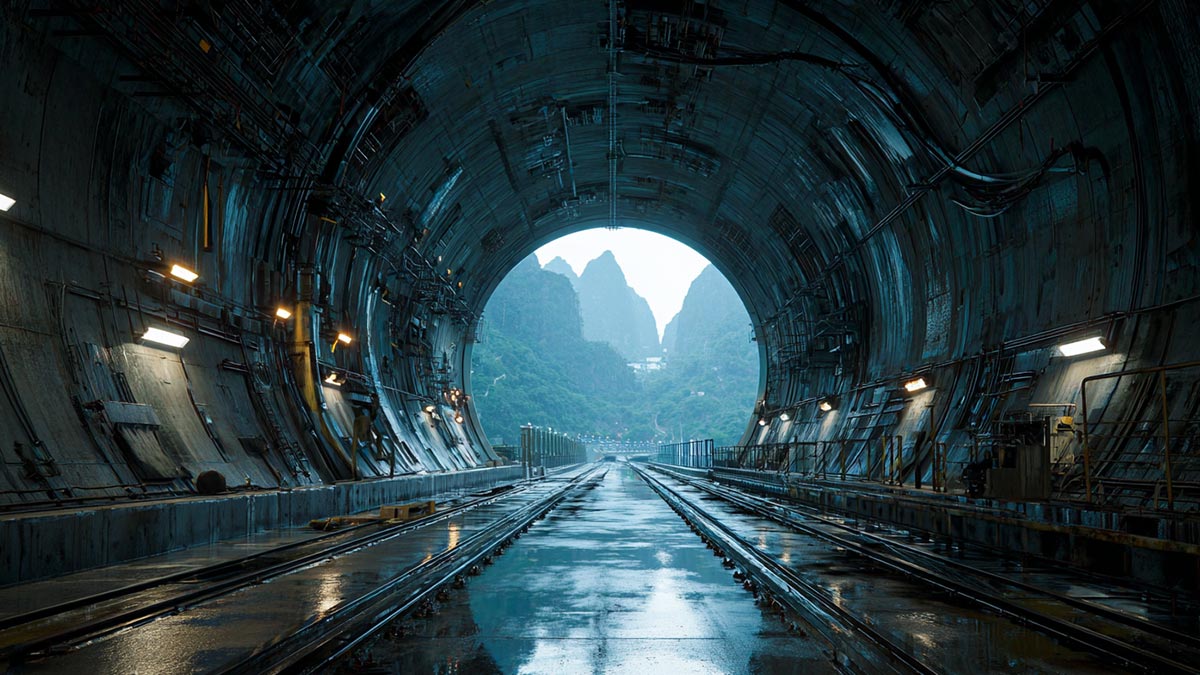
Imagine travelling for 20 uninterrupted minutes beneath solid rock — no daylight, no horizon, just concrete, ventilation shafts, and the hum of machinery. Somewhere deep inside a mountainous region of China, that experience is now a reality. A 22-kilometer tunnel — a structure so ambitious it has simultaneously drawn global admiration and sharp criticism — has broken records, rewritten engineering benchmarks, and ignited a conversation that stretches far beyond its concrete walls.
This is not simply a story about infrastructure. It is a story about power, ambition, displacement, and the uncomfortable space between technological wonder and political statement. It is the kind of project that makes you catch your breath — and then quietly ask: at whose expense?
A Tunnel That Feels Like a Political Statement
The moment you look at the blueprints, one thing becomes clear: this tunnel was never just about getting from one place to another faster. Stretching 22 kilometers through geologically treacherous terrain — riddled with tectonic fault lines, underground water systems, and seismic risk zones — it represents the kind of challenge that engineers spend entire careers dreaming about and dreading in equal measure.
Chinese state media has described the project as “a breakthrough for humanity.” That language sounds grandiose, almost theatrical. And yet, standing back and absorbing the sheer scale of what was accomplished, it is difficult not to feel a flicker of genuine awe.
But awe and unease are not mutually exclusive. This tunnel also connects regions in ways that accelerate the movement of goods, tighten the government’s logistical reach across remote territories, and — though never stated openly in official communications — simplifies military mobility in ways that strategic analysts have not failed to notice.
The official narrative is one of progress, development, reduced travel times, and increased prosperity. The quieter subtext reads differently: here is a demonstration of just how deeply a centralized state can reach into landscapes, communities, and the daily lives of millions of people — whether those people consented or not.
The Human Cost Behind the Headlines
Chinese state television ran a compelling documentary-style campaign alongside the construction. Cameras followed dust-covered workers drilling through solid rock. Interview clips captured exhausted faces beneath hard hats, speaking earnestly about “national pride.” It was polished, emotional, and cinematically impressive.
What those cameras did not linger on were the valleys and villages that existed before the construction crews arrived.
Officially, residents in affected areas were “resettled” — given new urban apartments, access to high-speed rail networks, and promises of improved opportunities. On paper, that sounds like progress. In practice, activists and affected individuals tell a markedly different story: one of pressure, delayed compensation, and a government that never genuinely asked whether anyone wanted to stay.
The Village in the Shadow of the Tunnel
One particularly telling example involves a small rural community that spent years living in the shadow of an enormous construction site. The official position was that residents would gain better housing in nearby cities and benefit from improved connectivity. For younger residents, perhaps that was true.
For older villagers, however, the calculus was entirely different. What they lost could not be measured in square footage or commute times. They lost ancestral graves, long-held daily routines, and the simple view of a familiar hillside that had defined their sense of place for generations. For them, the tunnel did not just pass beneath a mountain — it cut straight through the middle of their life story.
This is the detail that progress narratives almost always omit: technical advancement rarely produces only winners.
An Engineering Masterpiece — By Any Objective Measure
It would be intellectually dishonest to dismiss the tunnel’s technical achievements. By any engineering standard, this structure is extraordinary.
What Makes This Tunnel Remarkable
The construction incorporated:
- Multiple dedicated rescue and evacuation tubes running parallel to the main bore
- Advanced ventilation systems capable of maintaining air quality across the full 22-kilometer length
- Digital monitoring infrastructure with sensors measuring vibrations, structural integrity, and environmental conditions in real time
- Geotechnical innovations developed in collaboration with equipment manufacturers from Germany and Japan
- Round-the-clock construction shifts sustained over years, moving hundreds of thousands of tonnes of concrete and steel
Engineering specialists have described it as a new global reference point for long-distance tunnel construction — a project where software engineering, geotechnical science, and large-scale logistics converged at the highest level yet achieved.
The technical accomplishment is real. The question is not whether the tunnel works. The question is who it ultimately serves — and at what ongoing cost.
The Political Operating System Beneath the Engineering
Every major infrastructure project runs on two systems simultaneously: a technical one and a political one. In China’s case, the political operating system underlying this tunnel shares characteristics that recur across virtually all of the country’s mega-projects.
Recognizable Patterns of Authoritarian Infrastructure
- Spectacle over deliberation: Large-scale projects are framed as heroic national achievements rather than as policy choices weighed transparently against alternatives
- Speed over transparency: Record-breaking construction timelines are celebrated publicly, while environmental impact assessments proceed quietly in the background
- Symbols over lived experience: A Guinness World Record carries more narrative weight than the stress experienced by local communities during years of construction disruption
- Surveillance embedded in scale: The larger the project, the denser the accompanying network of cameras, access controls, and data collection systems
- National pride over individual rights: Those who raise objections are easily framed as selfish, uncooperative, or — most damagingly — “unpatriotic”
As one Chinese urban planner, speaking under the condition of anonymity, put it: “This tunnel is a monument — not only to engineering skill, but to a state determined to prove that no boundary exists that it cannot move.”
The Environmental Questions Nobody Is Answering Loudly
Official communications from the Chinese government invoke the language of “green development” when describing this and similar projects. The reality, according to independent geological experts, is considerably more complicated.
Concerns that have been raised — though rarely amplified in state-controlled media — include:
- Disruption to underground water systems that local agriculture and ecosystems depend upon
- Destabilization of hillsides and slopes along the tunnel corridor, with long-term subsidence risks
- Significant long-term maintenance burdens that will accumulate over decades and are rarely factored into the initial economic case for such projects
History offers a consistent lesson here: the true cost of mega-infrastructure projects almost never appears in the original budget. The bill arrives later — and it is rarely modest.
Why This Tunnel Is Not Someone Else’s Problem
It is tempting to treat a record-breaking tunnel in a remote Chinese mountain range as a distant spectacle — something to click on, share with a brief “wow,” and move past. That reaction, however comfortable, misses something important.
Projects of this scale are part of a strategic concept with consequences that ripple outward in multiple directions:
- Faster goods movement reshapes global supply chains and pricing structures
- Improved access to remote resource-rich regions affects international commodity markets
- Enhanced logistical infrastructure strengthens military mobility in strategically sensitive areas
- Tighter state control over peripheral territories has geopolitical implications extending well beyond China’s borders
A 22-kilometer tunnel cannot single-handedly reorganize the world order. But it is a highly visible symptom of a larger pattern — and that pattern has a way of connecting, eventually, to prices in European supermarkets, delivery timelines for manufactured goods, and the shifting balance of geopolitical leverage.
The Mirror This Tunnel Holds Up to All of Us
Perhaps the most uncomfortable dimension of this story is the one closest to home.
We celebrate mega-projects when they happen far away. We share drone footage of enormous bridges. We post admiring comments beneath time-lapse videos of skyscrapers rising overnight. There is something deeply human about being drawn to the monumental — to the evidence that human beings refuse to accept natural limits as permanent.
But the logic that produced this tunnel — build bigger, build faster, prioritize the record over the conversation — is not uniquely Chinese. It appears in highway expansion proposals, airport enlargement schemes, and “economic competitiveness” arguments in democratic countries too. The scale differs. The underlying impulse does not.
The 22-kilometer tunnel asks a question worth sitting with: Where does genuinely useful infrastructure end, and where does the compulsion to cover landscapes in concrete — simply because the capability exists — begin?
Slowing down long enough to ask that question does not make anyone anti-progress. It makes them honest about what progress actually costs.
Conclusion
China’s 22-kilometer record-breaking tunnel occupies an uncomfortable but important space in the global conversation about development, power, and accountability. It is, without question, a triumph of modern engineering — a structure that pushed the boundaries of what geotechnical science and construction logistics can achieve. The expertise, scale, and precision involved deserve genuine recognition.
It is, simultaneously, a monument to a system in which centralized authority overrides community consent, media management replaces genuine public debate, and the human cost of monumental ambition is absorbed quietly by those with the least power to resist.
The tunnel will carry trains and trucks and goods for decades to come. It will appear in engineering textbooks and infrastructure reports. It will be cited as evidence of what determined state investment can accomplish. All of that is true.
What is equally true — and equally worth remembering — is the village that no longer exists in the form it once did, the geological risks that remain unresolved, and the citizens who were never handed a clipboard and asked: “Do you agree?”
The next time a mega-project makes headlines anywhere in the world, the most important question is not how long or how fast or how deep. It is simply: who decides, who benefits, and who pays?
- → Nationwide Listeria Recall in France: What You Need to Know About Contaminated Pâtés and Cold Meats in 2026
- → The Unexpected Household Hack That Keeps Wet Floors and Entryways Clean in 2026
- → The Hair Transformation Women Over 50 Are Talking About in 2026: What Really Works for Thinning Hair
- → Marseille’s Mistral District in Crisis: Arrests, Secrets, and a Growing Mystery in 2026
- → Massive 35-Meter Waves in the Pacific: What Scientists Are Discovering in 2026
- → Why You’re Receiving More Spam Calls in 2026: The Hidden Reasons and How to Stop Them
- → The Express Chignon: A Quick and Elegant Hairstyle for Busy Women in 2026
Frequently Asked Questions (FAQs)
Q1: Where exactly is this 22-kilometer tunnel located in China? The tunnel runs through a mountainous region being developed for strategic transport and trade route purposes. Official communications emphasize improved connectivity to remote and previously isolated areas, though the precise strategic geography extends beyond simple civilian logistics.
Q2: What is the tunnel primarily used for? Depending on the specific project variant, the tunnel is designed for rail or road traffic, with the primary stated purpose of dramatically reducing travel times and accelerating the movement of goods. Military logistics applications are not acknowledged in official statements but are logistically straightforward given the tunnel’s location and design.
Q3: How safe are tunnels of this length from a technical standpoint? Long-distance tunnels of this scale incorporate dedicated rescue tubes, sophisticated ventilation systems, fire detection equipment, and clearly marked emergency evacuation routes. The engineering is genuinely advanced and impressive. However, the maintenance demands grow considerably over time, and the long-term costs of keeping a 22-kilometer tunnel fully operational are substantial.
Q4: Is there public criticism of this project within China? Open, visible public criticism is uncommon given the tight control exercised over Chinese media. Behind closed doors, however, affected residents and advocacy groups have reported significant concerns about displacement processes, environmental consequences, and the near-total absence of genuine community input into the decision-making process.
Q5: Why does this tunnel matter to people living outside China? Infrastructure projects of this scale influence global supply chains, shift economic dependencies, and carry geopolitical weight that extends far beyond the host country. They also serve as a revealing mirror for societies everywhere — prompting reflection on how any government, democratic or otherwise, balances large-scale development ambitions against community rights, environmental responsibility, and genuine public participation.




Leave a comment