

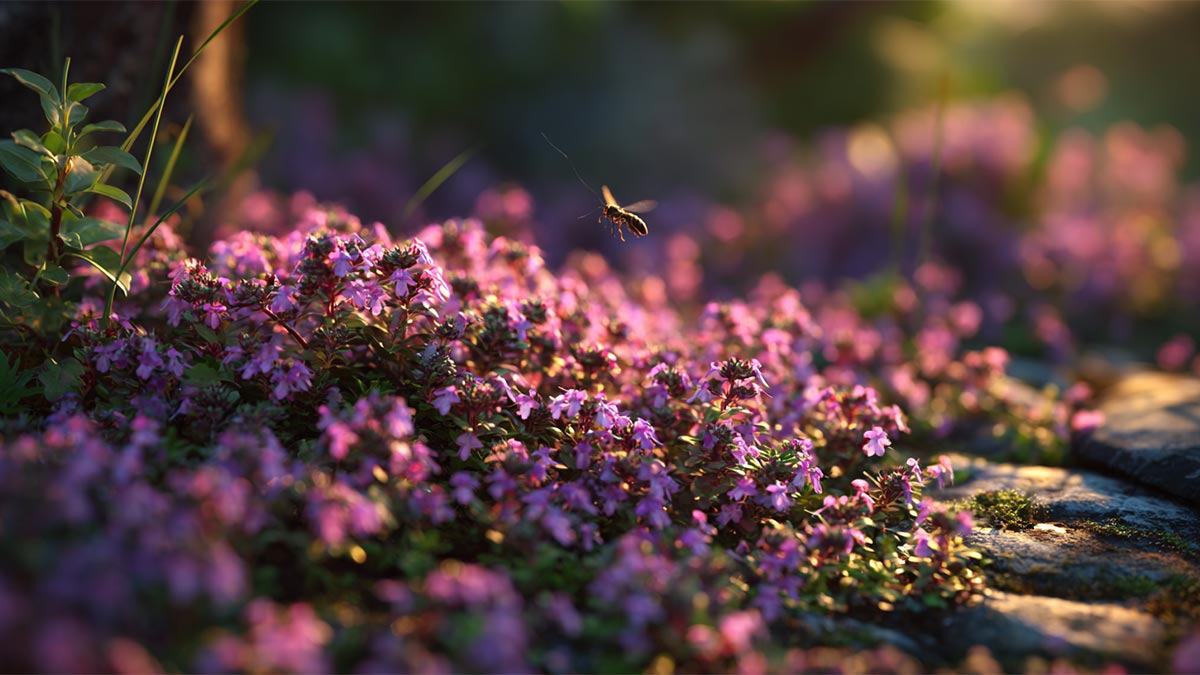
Every summer, the same problem returns — mosquitoes turning pleasant evenings outdoors into an exercise in frustration. Sprays and candles help briefly, but they don’t solve anything. What if the answer was growing quietly in the ground beneath your feet? Across Europe and North America, a growing number of homeowners are discovering that red creeping thyme — a low-growing, flowering, wonderfully fragrant perennial — does something no lawn grass ever could: it keeps mosquitoes away naturally, blooms with beautiful purple flowers, and asks almost nothing in return.
If you haven’t planted it yet, this month is the time to act.
What Is Red Creeping Thyme and Why Is Everyone Talking About It?
A Ground Cover That Does Far More Than Look Pretty
Red creeping thyme (Thymus praecox) is a hardy, mat-forming perennial that hugs the ground as it spreads, producing dense carpets of tiny aromatic leaves topped with delicate purple-pink flowers each summer. It grows only a few inches tall, tolerates foot traffic surprisingly well, and thrives in conditions where many other plants struggle — particularly in full sun and well-drained soil.
What distinguishes it from every other decorative ground cover, however, is what it does invisibly: it continuously releases natural aromatic compounds into the surrounding air that mosquitoes find deeply repellent. This combination of beauty, practicality, and near-zero maintenance has made it one of the most talked-about plants in modern low-maintenance gardening.
The Mosquito-Repelling Science Behind Red Creeping Thyme
What’s Actually Happening at the Chemical Level
The mosquito-deterring power of red creeping thyme isn’t folklore — it has a solid scientific basis. The plant’s leaves are rich in volatile organic compounds, most notably carvacrol and thymol, which are continuously released into the air as the plant grows and especially when its leaves are disturbed or brushed.
According to entomology research, these compounds overwhelm mosquitoes’ sensory receptors, effectively disrupting their ability to detect and locate potential hosts. The result is an invisible aromatic barrier that sends mosquitoes elsewhere without requiring any sprays, plug-in devices, or chemical treatments.
A Passive, Continuous Defence
Unlike a citronella candle that burns out or a spray that wears off within hours, red creeping thyme works passively and continuously throughout the season. As long as the plant is growing and healthy, it is releasing its natural repellent compounds — day and night, with no effort required from you.
Why Planting Before the End of the Month Matters
Timing Is Everything with This Plant
The window for getting red creeping thyme established before peak mosquito season is narrow but important. Planting by the end of May or in early June gives the plant sufficient time to develop a strong root system and begin producing its essential oils at full intensity before the height of summer — and before mosquito activity peaks.
Plants that go in the ground too late may still establish and grow, but they won’t have the same head start. The earlier in the season you plant, the faster the thyme will spread, fill bare ground, and build the kind of dense, aromatic carpet that creates a meaningful barrier around your outdoor living spaces.
In warmer climates, planting can begin slightly earlier in spring. In cooler regions, waiting until the risk of late frost has completely passed is advisable — but the sooner after that point the better.
Where to Plant Red Creeping Thyme for Maximum Effect
Identifying the Best Locations in Your Garden
One of red creeping thyme’s greatest strengths is its adaptability. It performs best in full sun — at least six hours of direct sunlight daily — but can tolerate partial shade, making it suitable for a wider range of garden positions than many sun-loving plants.
The most strategically effective placements include:
- Around outdoor seating areas and dining zones — where the aromatic barrier is most needed
- Along pathways and stepping stones — where foot traffic brushes the leaves and releases extra fragrance
- Near windows and doorways — to discourage mosquitoes from gathering at entry points
- Between paving slabs and in gaps — where it fills beautifully and suppresses weeds
- Along the edges of raised beds and containers — where it cascades attractively over the sides
Its low, spreading growth habit makes it ideal for any situation where you want attractive, functional ground cover that doesn’t require constant management.
How to Plant Red Creeping Thyme: A Step-by-Step Guide
Soil Preparation
Red creeping thyme prefers sandy, slightly acidic, well-drained soil. Heavy clay or waterlogged ground is its biggest enemy. If your soil retains moisture, improve drainage before planting by incorporating grit or coarse sand. Avoid adding excessive organic matter or fertiliser — this plant actually prefers leaner soil conditions and performs better without a rich feed.
- → Nationwide Listeria Recall in France: What You Need to Know About Contaminated Pâtés and Cold Meats in 2026
- → The Unexpected Household Hack That Keeps Wet Floors and Entryways Clean in 2026
- → The Hair Transformation Women Over 50 Are Talking About in 2026: What Really Works for Thinning Hair
- → Marseille’s Mistral District in Crisis: Arrests, Secrets, and a Growing Mystery in 2026
- → Massive 35-Meter Waves in the Pacific: What Scientists Are Discovering in 2026
- → Why You’re Receiving More Spam Calls in 2026: The Hidden Reasons and How to Stop Them
- → The Express Chignon: A Quick and Elegant Hairstyle for Busy Women in 2026
Planting Steps
Start by clearing the planting area of weeds thoroughly, as newly planted thyme can be outcompeted before it establishes. Space individual plants 18 to 24 inches apart — they will spread and fill the gaps over the course of the season. Plant at the same depth as the nursery pot, firm the soil gently around the roots, and water in well.
Watering During Establishment
Consistent moisture during the first few weeks is essential while the root system develops. Once established — usually within four to six weeks — red creeping thyme becomes significantly drought-tolerant and requires very little supplemental watering. Overwatering an established plant is actually more damaging than underwatering.
The Full Range of Benefits Red Creeping Thyme Offers
Beyond Mosquito Control
The mosquito-repelling quality gets most of the attention, but red creeping thyme brings a remarkably broad set of benefits to any garden:
Weed suppression — its dense, mat-forming coverage shades out weeds effectively, reducing the need for manual weeding or mulching.
Drought resistance — once established, it needs minimal watering, making it an excellent choice for gardens in areas with water restrictions or hot, dry summers.
Pollinator attraction — the purple flowers are a significant draw for bees and butterflies, supporting local pollinator populations throughout the blooming season.
Lawn replacement potential — in areas where traditional turf grass struggles or demands too much water and maintenance, red creeping thyme offers a fragrant, visually appealing, and genuinely practical alternative.
Sensory ambience — the herb-like fragrance creates a naturally calming atmosphere in outdoor spaces, enhancing the experience of spending time in the garden.
How Red Creeping Thyme Compares to Other Mosquito-Repelling Plants
| Plant | Mosquito Repellency | Maintenance Level | Growth Habit |
|---|---|---|---|
| Red Creeping Thyme | Highly effective | Low | Spreading, mat-forming |
| Citronella | Moderately effective | Moderate | Upright, clumping |
| Lavender | Somewhat effective | Moderate | Upright, bushy |
| Catnip | Moderately effective | Low | Spreading, mat-forming |
Among the commonly recommended mosquito-repelling plants, red creeping thyme stands out for combining high repellency with low maintenance and a ground-covering growth habit — a combination none of the alternatives fully match. Citronella and lavender offer some protection but require more care and don’t spread to create continuous coverage. Catnip spreads similarly but lacks the ornamental appeal and fragrant versatility of thyme.
Potential Drawbacks to Consider
It Can Spread Aggressively
Red creeping thyme’s enthusiasm for spreading is one of its greatest strengths — and its one significant drawback. In an open planting area, this is ideal. In a mixed border where it might encroach on neighbouring plants, it requires periodic edging and trimming to keep it in its intended zone. Planting it in a defined space or using physical root barriers can help manage this tendency.
The Fragrance Isn’t for Everyone
While the aromatic quality is widely considered a selling point, individuals with sensitivities to thyme or related herbs, or those who simply find strong herbal scents overpowering in an enclosed outdoor space, may want to test the fragrance before committing to a large planting. A single pot or small trial area is worth trying first.
Practical Planting Scenarios
| Garden Setting | How Red Creeping Thyme Helps |
|---|---|
| Small urban patio or balcony | Grows well in containers; creates a fragrant, mosquito-deterring perimeter |
| Large suburban garden | Replaces water-hungry turf grass as a low-maintenance ground cover |
| Outdoor entertaining area | Planted around seating zones, it creates a natural insect barrier |
| Partially shaded beds | Tolerates reduced light while still spreading and flowering effectively |
Conclusion
Red creeping thyme is one of those rare garden plants that genuinely earns every superlative applied to it. It flowers prolifically, smells wonderful, demands almost nothing, survives drought, supports pollinators, suppresses weeds, can replace an entire lawn — and it keeps mosquitoes away through the entire summer season without a single spray or candle. The key is getting it in the ground before the end of the month, giving it the time it needs to spread and build its aromatic defences before peak mosquito season arrives. Whether you have a sprawling garden or a compact balcony, a sunny border or a partly shaded corner, red creeping thyme has a role to play. Plant it once, and it will quietly transform your outdoor space for years to come.
Frequently Asked Questions
When is the best time of year to plant red creeping thyme? Late spring to early summer — ideally before the end of May or in early June — is the optimal planting window. This allows the plant to establish fully before mosquito season reaches its peak.
How much sunlight does red creeping thyme require? It thrives in full sun and needs a minimum of six hours of direct sunlight per day. It can tolerate partial shade but may spread more slowly and produce fewer flowers in lower-light conditions.
Is red creeping thyme difficult to maintain? It’s one of the lowest-maintenance ground covers available. Once established, it needs minimal watering, occasional trimming to keep its spread in check, and no feeding beyond what the natural soil provides.
How effective is it at actually repelling mosquitoes? Highly effective. The carvacrol and thymol compounds in its leaves create a continuous aromatic deterrent that disrupts mosquitoes’ ability to locate hosts, reducing their presence significantly around planted areas.
Can it be grown successfully in containers? Yes. Red creeping thyme adapts well to pots, planters, and hanging baskets, making it suitable for balconies, patios, and other small outdoor spaces where in-ground planting isn’t possible.
How quickly does it spread? In good conditions — full sun and well-drained soil — it spreads relatively quickly within a single season, filling gaps and forming a dense mat that becomes denser each year.
What are the main drawbacks? Its aggressive spreading habit can require management in mixed planting areas, and its strong herbal fragrance may not suit everyone. Both issues are manageable with a little planning.
Can red creeping thyme replace a traditional lawn? Yes, particularly in sunny, well-drained areas. It creates a fragrant, visually attractive, low-maintenance alternative to turf grass that requires far less water, no mowing, and no fertilising.



Leave a comment