

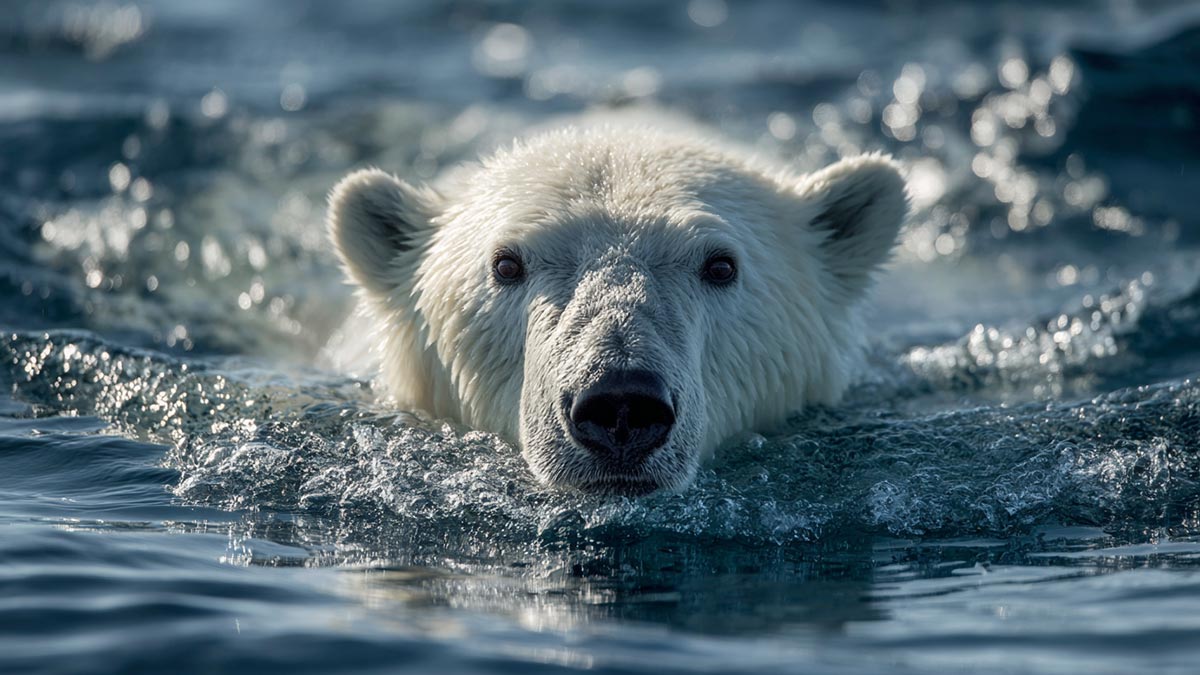
When a tiny blinking dot began moving steadily across hundreds of miles of open Arctic water on a research team’s computer screen, the scientists watching couldn’t believe what they were seeing. GPS tracking doesn’t lie — but what it was showing seemed impossible. A young polar bear was swimming across a vast, ice-free expanse of ocean, far beyond any distance previously recorded for the species.
What began as a routine data check quickly became one of the most astonishing wildlife discoveries in recent Arctic research history.
An Unexpected Find at a Remote Arctic Research Station
The events unfolded at a secluded research outpost where a team of marine biologists was using cutting-edge GPS collar technology to monitor polar bear movements in near real-time. The system allowed researchers to observe the animals’ behavior and habitat patterns with a level of precision that was previously impossible.
During a standard review of the tracking data, something unusual caught their attention — a signal moving continuously across open water at a pace and scale that defied expectations. “At first, we assumed it had to be a technical malfunction,” recalled Dr. Emily Harrington, the station’s lead scientist. “The bear was covering a distance that simply didn’t seem physically possible.”
But the signal kept moving. Hour after hour, the data confirmed what the researchers could barely accept: a young polar bear was swimming steadily across an extraordinary stretch of open ocean. “We were completely stunned,” said Harrington. “Nothing like this had ever been documented before, and it overturned much of what we thought we understood about these animals.”
Pushing Past the Known Limits of Polar Bear Swimming
Polar bears are naturally equipped for cold-water environments. Their oversized front paws function like built-in paddles, and a dense layer of body fat provides critical insulation in near-freezing waters. Despite these adaptations, the species has historically been considered a moderate swimmer at best — with most recorded open-water swims capped at a few dozen miles.
This particular bear shattered that understanding entirely.
“The dot on our screen just kept moving — for well over 100 miles of open ocean,” Harrington said. “For a young bear of that age and body size, this is genuinely unprecedented.”
Scientists are still working to fully explain how the animal sustained such an effort. Dr. Lena Petersen, a polar bear specialist at the University of the Arctic, offered one possibility: “The bear may have been driven by urgency — searching for food or trying to reach land. But whatever the motivation, the physical endurance it demonstrated suggests these animals possess a resilience we hadn’t fully appreciated before.”
The Role of Climate Change in Forcing Extreme Behavior
This record-breaking swim didn’t happen in isolation. It is symptomatic of a much larger and more troubling pattern unfolding across the Arctic. As global temperatures continue to rise, the sea ice that polar bears depend on for hunting, resting, and rearing young is retreating at an alarming rate.
The data paints a stark picture:
| Arctic Sea Ice Extent | 1980s Average | 2022 Minimum |
|---|---|---|
| September | 7.05 million sq km | 4.67 million sq km |
| March | 15.64 million sq km | 14.24 million sq km |
With traditional ice platforms disappearing, polar bears are increasingly being pushed into open water, forced to cover far greater distances in search of stable ground and food sources. “We are witnessing more and more cases of bears attempting these long-distance swims, sometimes with fatal outcomes,” said Petersen. “The physical demands being placed on these animals are growing more extreme with every passing year.”
Dr. Harrington echoed this concern: “This bear’s swim is a testament to the adaptability of the species — but it is equally a warning signal about what climate change is forcing these animals to endure.”
Why This Young Bear May Have Had a Survival Advantage
Interestingly, the bear’s youth and relatively small body size may have contributed to its ability to complete such an extraordinary journey. Scientists believe younger, smaller bears tend to have a more favorable fat-to-body-mass ratio, which helps them retain heat and manage energy consumption more efficiently during prolonged swims.
“Smaller bears benefit from a better surface-to-volume ratio,” Harrington explained. “This can work in their favor when it comes to conserving warmth and sustaining energy over long distances.”
The researchers also theorize that the animal may have used creative survival strategies along the way — resting on small ice floes when available, and potentially hunting opportunistically during the journey. “That kind of adaptive thinking, if it’s what happened, is essential for survival in an environment that is changing this rapidly,” said Petersen.
Swim Distance Benchmarks: What the Data Tells Us
| Polar Bear Category | Average Swim Distance | Maximum Recorded |
|---|---|---|
| Adult Polar Bear | 20–60 miles | Over 100 miles |
| Young Polar Bear | 10–30 miles | Over 150 miles |
The fact that the young bear in this case surpassed even the adult maximum is what makes this observation so scientifically significant.
Survival Uncertainty: Did the Bear Make It?
Despite the wonder this discovery inspired, it comes with a sobering footnote. The researchers were unable to confirm whether the bear successfully reached land or perished before completing its journey. “We don’t know the outcome for this individual,” Harrington acknowledged. “Its fate is one small piece of a much bigger and deeply uncertain picture.”
As Arctic ice continues to diminish, survival swims like this one may transition from rare anomalies to a regular feature of polar bear life. “The question is not whether polar bears can adapt,” said Petersen. “The question is how long they can sustain this level of physical strain before the system fails them entirely.”
How GPS Technology Is Reshaping Arctic Research
None of this would have been possible without significant advances in GPS and satellite tracking systems. By fitting polar bears with high-precision collars, the team at Research Station Delta can now collect detailed behavioral and movement data in real time — revealing patterns that would have been entirely invisible just a decade ago.
“The depth of insight we can now gather from this technology is extraordinary,” said Harrington. “We can see things happening in real time that used to be pure guesswork.”
That said, the researchers are candid about the limitations of current tools and the need to keep innovating. “As conditions in the Arctic evolve, our methods have to evolve with them,” Petersen noted. “Developing new tracking and analysis approaches is essential for keeping pace with a rapidly transforming ecosystem.”
What This Discovery Means for Conservation Policy
Beyond the realm of science, this finding has energized conservation advocates who see it as a compelling argument for urgent policy action. Sarah Olson, Director of the Arctic Conservation Alliance, described the bear’s swim as a powerful symbol of what is at stake. “This story needs to be heard widely,” she said. “It should motivate governments and communities to pursue meaningful, large-scale responses to the climate crisis.”
Conservation strategies currently in place include protected habitat designations, regulated hunting restrictions, and international advocacy for stronger climate commitments. But experts stress that these efforts, while valuable, must be dramatically expanded if polar bear populations are to remain viable over the coming decades.
Individuals, too, have a role to play — through reducing personal carbon emissions, supporting Arctic conservation organizations, and advocating for evidence-based climate policies.
Broader Implications for Our Understanding of the Arctic
Perhaps most importantly, this discovery challenges the scientific community to reconsider long-held assumptions about the Arctic ecosystem and the creatures within it. “This observation forces us to rethink the boundaries of what polar bears are capable of,” said Harrington. “They may be far more adaptable than our models have assumed — but that adaptability has a limit, and we are pushing it.”
The insights gathered from this single tracking event have the potential to reshape conservation planning, influence climate policy discussions, and deepen our understanding of how wildlife responds to environmental stress at a systemic level.
Future Research: What Comes Next
The team at Research Station Delta is already expanding its monitoring efforts in light of this discovery. Priority research areas now include a deeper investigation into the physiological mechanisms behind long-distance swimming endurance, the behavioral strategies bears use to manage energy during extended open-water travel, and how population health trends are shifting in response to accelerating ice loss.
“This event has opened doors we didn’t even know existed,” said Petersen. “There is now so much more we need to learn — and so much more at stake if we don’t.”
Conclusion
A single GPS collar on a young polar bear produced one of the most striking wildlife revelations in recent memory — and one of the most urgent. This animal’s extraordinary swim across more than 150 miles of open Arctic ocean is simultaneously a story of remarkable biological resilience and a sobering reflection of what climate change is demanding from the natural world.
The disappearing sea ice is not an abstract environmental statistic. For polar bears, it is a daily, life-or-death reality. As researchers continue to study and document these changes, the responsibility to act falls on all of us — scientists, policymakers, and individuals alike. The Arctic is sending a clear signal. The only question remaining is whether we will respond in time.
Frequently Asked Questions
How far can polar bears typically swim? Adult polar bears generally swim between 20 and 60 miles, while younger bears average between 10 and 30 miles. The young bear documented in this case surpassed 150 miles, making it a record-breaking and scientifically unprecedented event.
- → Nationwide Listeria Recall in France: What You Need to Know About Contaminated Pâtés and Cold Meats in 2026
- → The Unexpected Household Hack That Keeps Wet Floors and Entryways Clean in 2026
- → The Hair Transformation Women Over 50 Are Talking About in 2026: What Really Works for Thinning Hair
- → Marseille’s Mistral District in Crisis: Arrests, Secrets, and a Growing Mystery in 2026
- → Massive 35-Meter Waves in the Pacific: What Scientists Are Discovering in 2026
- → Why You’re Receiving More Spam Calls in 2026: The Hidden Reasons and How to Stop Them
- → The Express Chignon: A Quick and Elegant Hairstyle for Busy Women in 2026
What physical traits help polar bears swim long distances? Polar bears are equipped with large, paddle-like front paws, a thick insulating fat layer, and an energy-efficient body composition. Younger bears may also benefit from a higher fat-to-mass ratio that aids heat retention and endurance during long swims.
How does climate change threaten polar bear survival? Shrinking Arctic sea ice removes the platform polar bears rely on for hunting seals, resting, and raising cubs. This forces them to undertake increasingly long and exhausting swims, depleting energy reserves and raising mortality risks — particularly for cubs and young bears.
What conservation measures currently protect polar bears? Existing protections include designated wildlife sanctuaries, limits on hunting, and international agreements targeting greenhouse gas emissions. Experts widely agree, however, that significantly more aggressive action is needed to secure the species’ long-term future.
How can the public contribute to polar bear conservation? Individuals can support reputable conservation organizations financially, work to reduce their own carbon footprint, and advocate for strong climate legislation. Public awareness and political pressure remain among the most powerful tools for driving meaningful change.
What new research questions has this discovery raised? Scientists are now focused on understanding the physiological adaptations behind extreme swimming endurance, how bears manage energy and rest during long open-water journeys, and the long-term health consequences of climate-driven behavioral changes across entire populations.
How does this event change our view of the Arctic ecosystem? It demonstrates that some species may possess greater adaptive capacity than previously understood — but also that this adaptability is being stretched to its limits. It reinforces the interconnected fragility of Arctic wildlife and the cascading risks posed by continued warming.
What are the next steps for the Research Station Delta team? The team is intensifying GPS tracking efforts, exploring next-generation data collection technologies, and pursuing interdisciplinary research to better understand how polar bears and other Arctic species are coping with — and being reshaped by — a rapidly changing environment.




Leave a comment