

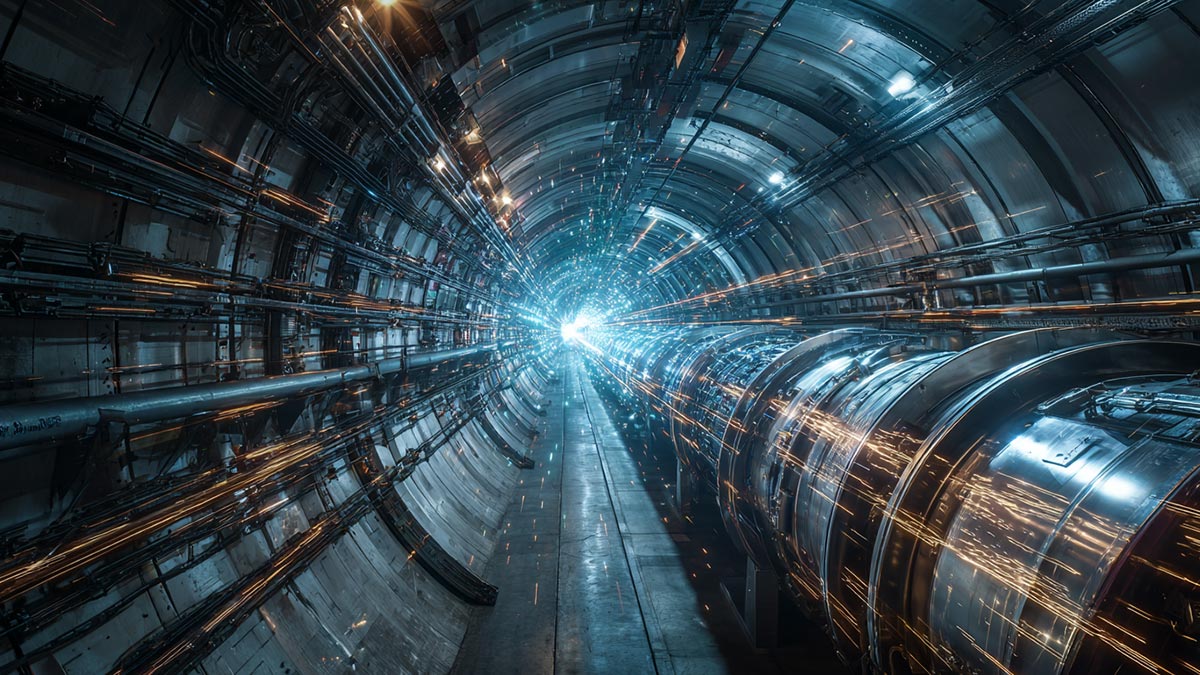
For years, China had been quietly positioning itself to dethrone Europe as the dominant force in particle physics. That ambition has now hit a wall. Beijing has officially suspended development of the Circular Electron Positron Collider (CEPC) — a colossal scientific undertaking that would have been the largest particle accelerator ever built — citing a price tag too steep to justify, even by China’s considerable financial standards.
A Vision That Outgrew Its Budget
The CEPC was conceived as China’s definitive answer to the European Large Hadron Collider (LHC) operated by CERN. Planned with a circumference of roughly 100 kilometers, the machine was designed to probe the deepest mysteries of matter and energy, pushing particle physics into entirely uncharted territory.
But as development progressed, estimated costs surged to approximately $35 billion — a figure that dwarfed early projections and strained even China’s government-backed funding model. The sheer engineering demands of the project — including excavation of a vast underground tunnel and the design of next-generation accelerator components — drove expenses far beyond what original blueprints had anticipated. Ultimately, Chinese policymakers concluded that channeling such an extraordinary sum into a single research facility could no longer be defended against the country’s broader investment priorities.
Europe’s Own Struggles With Big Physics
China’s withdrawal from the race comes at a time when Europe, too, is wrestling with the financial weight of next-generation particle physics. CERN’s LHC, situated along the Franco-Swiss border, remains operational and productive, but discussions about its proposed successor — the Future Circular Collider (FCC) — have grown increasingly complicated.
The FCC, if ever greenlit, would rival the CEPC in scale, spanning a proposed circumference of nearly 100 kilometers. Securing the international funding and political will required for such a venture has proven a formidable challenge, and the project’s fate continues to hang in the balance. In this sense, China’s predicament is less an anomaly and more a reflection of a global pattern: megascale science is becoming almost prohibitively expensive for any single nation — or coalition of nations — to sustain.
What Tipped the Financial Scales?
Scientific megaprojects rarely collapse overnight. They reach a tipping point — a threshold at which projected returns no longer justify the staggering resources required. For the CEPC, that threshold was crossed when costs ballooned to a level that competing national priorities simply could not accommodate.
Experts point out that when a single project begins consuming resources that could otherwise fuel multiple high-impact research programs, governments are compelled to reassess. China’s leadership appears to have made precisely that calculation — recognizing that the opportunity cost of proceeding with the CEPC was too high relative to its anticipated scientific yield over the coming decades.
The Geopolitics Behind the Science
The competition to host the world’s most powerful particle accelerator has never been purely about physics. It carries enormous symbolic weight — a demonstration of technological sophistication, scientific ambition, and national prestige. China’s push for the CEPC was widely interpreted as a deliberate move to challenge Europe’s long-standing dominance of high-energy physics research.
With the project now on ice, China has — at least temporarily — stepped back from that contest, leaving CERN and its European partners in an unchallenged position at the forefront of the field. The geopolitical ripple effects of this decision extend beyond laboratories, influencing how nations frame their scientific diplomacy and where the next generation of top researchers chooses to work.
How Scientists Are Responding
Reactions from the global physics community have been a blend of frustration and reluctant acceptance. Researchers who had pinned hopes on the CEPC acknowledge the project’s transformative potential, yet few were entirely caught off guard by its suspension.
Dr. Emma Zheng of the Chinese Academy of Sciences noted that while the pause is disappointing, the financial and logistical hurdles of constructing something at that scale were always immense, and China’s leadership made a pragmatic call to redirect resources accordingly. Meanwhile, Dr. Liam Fitzgerald of CERN cautioned that the decision could send shockwaves through the broader scientific community, potentially undermining international momentum and collaborative frameworks that take years to build.
What This Means for the Future of Particle Physics
The CEPC’s suspension does not signal the end of particle physics ambition — it signals a recalibration. The LHC at CERN continues to generate landmark discoveries, and researchers worldwide are actively developing alternative pathways to advance the field. Smaller-scale experimental setups, novel detector technologies, and the integration of quantum computing into physics research are all being explored as complementary or supplementary approaches.
The CEPC experience also reinforces a broader shift in how the scientific community is thinking about large-scale infrastructure. Rather than a single nation bearing the full burden of a multi-decade, multi-billion-dollar construction project, there is growing consensus that future colliders — if they are to be built at all — will require deep, sustained international partnerships from the outset.
China’s Science Strategy Going Forward
The halt is best understood not as a retreat, but as a strategic recalibration within China’s overall science and technology agenda. The country remains deeply committed to advancing its research capabilities, with growing investments in quantum computing, artificial intelligence, and clean energy technologies taking center stage.
Particle physics has not been abandoned — China is expected to maintain its presence in the field through more targeted domestic initiatives and continued collaboration with global partners on international projects. The CEPC’s suspension simply reflects a more disciplined framework for evaluating where limited resources can deliver the greatest long-term impact.
Conclusion
The suspension of China’s Circular Electron Positron Collider stands as one of the most telling episodes in modern science policy. It illustrates that even the most resource-rich nations are not immune to the financial gravity of big science. With costs ballooning to $35 billion, the project became impossible to justify against competing national priorities — and Beijing made the pragmatic choice to step back.
This decision carries lessons that stretch far beyond Chinese physics labs. For the global scientific community, it underscores the urgent need for smarter international cost-sharing, more rigorous project planning, and a realistic appraisal of what any single country — however prosperous — can sustain alone. The dream of a 100-kilometer supercollider has not died; it has simply been deferred, waiting for the right combination of political will, international cooperation, and financial feasibility to bring it back to life.
FAQs
Why did China halt the CEPC project? The primary driver was cost escalation. The project’s estimated budget had climbed to roughly $35 billion — far beyond initial forecasts — making it financially unsustainable relative to China’s other research and infrastructure priorities.
What made the CEPC so expensive to build? The project required the construction of a massive underground tunnel spanning approximately 100 kilometers, along with the development of highly specialized accelerator technology — both of which demanded enormous financial and engineering resources.
Does this setback damage China’s scientific reputation globally? To some extent, it cedes ground in particle physics prestige to Europe and CERN. However, China’s broader scientific ambitions — spanning AI, quantum computing, and renewable energy — remain very much intact and on the rise.
Will China walk away from particle physics entirely? No. China is expected to continue participating in the field through more focused domestic experiments and international collaborative projects, even without a flagship collider of its own in the near term.
What does this mean for Europe’s Future Circular Collider (FCC)? The FCC faces comparable funding and logistical obstacles. China’s experience highlights the systemic difficulty of financing such projects and may intensify pressure on European stakeholders to secure broader international backing.
- → Nationwide Listeria Recall in France: What You Need to Know About Contaminated Pâtés and Cold Meats in 2026
- → The Unexpected Household Hack That Keeps Wet Floors and Entryways Clean in 2026
- → The Hair Transformation Women Over 50 Are Talking About in 2026: What Really Works for Thinning Hair
- → Marseille’s Mistral District in Crisis: Arrests, Secrets, and a Growing Mystery in 2026
- → Massive 35-Meter Waves in the Pacific: What Scientists Are Discovering in 2026
- → Why You’re Receiving More Spam Calls in 2026: The Hidden Reasons and How to Stop Them
- → The Express Chignon: A Quick and Elegant Hairstyle for Busy Women in 2026
What broader lessons does the CEPC saga offer? It demonstrates that even the most ambitious scientific endeavors must be grounded in financial reality. Successful megaprojects of the future will likely require multinational cost-sharing, phased investment models, and transparent feasibility assessments from the very beginning.




Leave a comment