

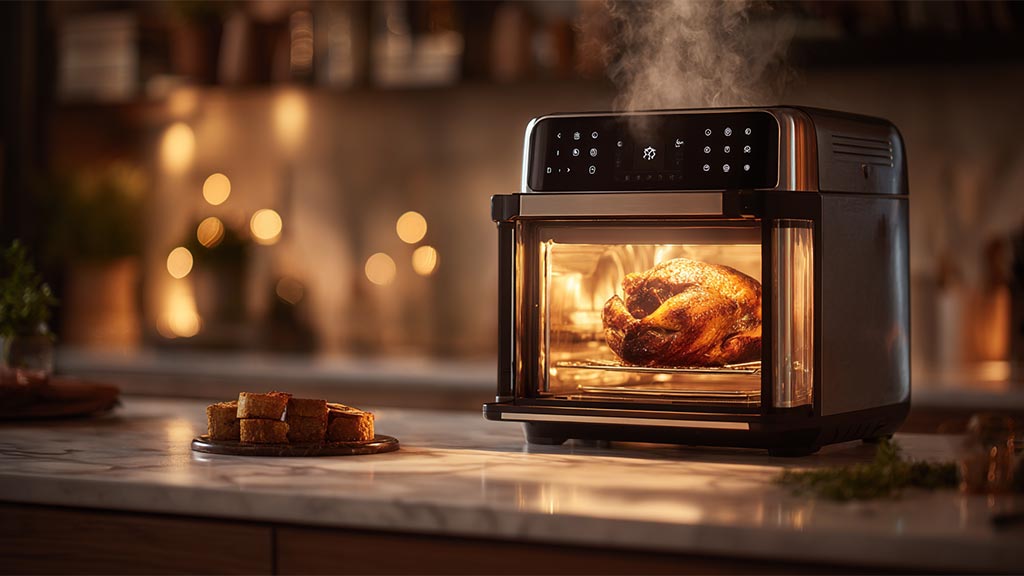
Picture a typical weeknight kitchen: a pot of pasta bubbling on the hob, an air fryer rattling away in the corner, and a counter so crowded with gadgets it looks like a small appliance showroom. The blender, the toaster, the rice cooker, and that air fryer everyone panic-bought during lockdown and now mostly uses for frozen chips.
Then something different showed up. A compact, slightly futuristic unit with a glass door and a surprisingly approachable control panel. Its claim? One machine capable of frying, roasting, steaming, slow cooking, baking, grilling, dehydrating — and then some. Suddenly, the air fryer started looking a little limited.
How the Air Fryer Went From Hero to Has-Been
The air fryer earned its place on the counter with a straightforward pitch: crispier food, less oil, fewer calories. It delivered, and millions of households welcomed one in. For a while, chicken wings and sweet potato fries were being tossed in daily with genuine enthusiasm. Then reality crept back in — long workdays, busy family schedules, fridges running on empty. The air fryer gradually became just another noisy box, reliable for reheating nuggets but not much else.
When appliance brands began marketing a “next generation” cooking device, most people were understandably sceptical. Another gadget? Another trend to ignore in six months? The scepticism faded quickly once people realised this wasn’t a single-trick machine. It was built around nine distinct cooking functions.
What Nine Cooking Modes Actually Look Like in Real Life
Imagine a single countertop appliance that slow-cooks a beef stew overnight, switches to steaming vegetables at lunchtime, and then grills a whole chicken to a golden finish for dinner — all without dragging out multiple pots, pans, or separate appliances. No kitchen chaos, no overheating the room.
Sarah, a nurse in her thirties, describes this kind of multi-cooker as having genuinely given her evenings back. She loads ingredients before leaving for work, sets the programme, and returns home to a meal that’s been cooking without her. No hovering, no last-minute scramble.
Another home cook admits he hasn’t switched on his full-sized oven in over three months. The new appliance now occupies the spot where his air fryer used to sit, but it has quietly replaced his steamer, toaster oven, and yogurt maker as well. At that point, it stops feeling like a gadget and starts functioning like a reliable kitchen assistant.
The Nine Cooking Methods — And Why the Combination Matters
Depending on the specific model, the functions typically available include: air fry, convection bake, classic bake, steam, steam-bake, grill, slow cook, sauté, and dehydrate. Some higher-end versions go further, adding dough-proofing or sous-vide style modes.
The real power isn’t simply the quantity of modes — it’s how intelligently they overlap and complement each other.
- Steam-bake produces golden, crackly crusts with soft, moist centres
- Air fry combined with grill crisps up chicken skin without stripping the meat of moisture
- Slow cook followed by a short grill blast transforms a cheap cut of pork into pulled meat with caramelised edges
This is precisely where the standard air fryer reveals its limitations. It does one thing well: circulate hot air quickly. It doesn’t negotiate between moisture and crispness. The multi-cooker doesn’t just speed up cooking — it fundamentally changes the kind of cooking you’re capable of.
A Practical Guide to Getting Started Without Feeling Overwhelmed
The most effective way to approach a machine with this many functions is to think of it initially as three familiar appliances rolled into one: your air fryer, your oven, and a gentle steamer. Start with what you already know.
In the early weeks, lean on air fry mode for the same weeknight staples you’d normally cook — fish fillets, vegetable pieces, pre-cut potatoes. Once the controls feel natural, step it up. Try steam-bake for salmon and vegetables on the same tray. The result is juicy fish, tender greens, and a lightly roasted finish in under fifteen minutes.
- → Nationwide Listeria Recall in France: What You Need to Know About Contaminated Pâtés and Cold Meats in 2026
- → The Unexpected Household Hack That Keeps Wet Floors and Entryways Clean in 2026
- → The Hair Transformation Women Over 50 Are Talking About in 2026: What Really Works for Thinning Hair
- → Marseille’s Mistral District in Crisis: Arrests, Secrets, and a Growing Mystery in 2026
- → Massive 35-Meter Waves in the Pacific: What Scientists Are Discovering in 2026
- → Why You’re Receiving More Spam Calls in 2026: The Hidden Reasons and How to Stop Them
- → The Express Chignon: A Quick and Elegant Hairstyle for Busy Women in 2026
On weekends, experiment with the slower modes. Load the slow cook setting with beef, root vegetables, herbs, and stock in the morning. Leave it. At the end of the day, give it five to ten minutes on grill or bake to brown the surface. The outcome tastes like an all-day kitchen project when it largely looked after itself.
The most common mistake people make is attempting every function in the first week, hitting a wall of complexity, and reverting to old habits. A far more sustainable approach is introducing one new mode per week. Master air fry and bake first. Add steam the following week. Explore slow cook the week after that.
The second mistake is treating the machine as though it’s infallible. These appliances are powerful and cook fast — an extra five minutes can push a perfectly cooked dish into overdone territory. Use the glass door, check on food mid-cycle, taste and adjust. The marketing rarely says this plainly: the machine is the tool, but you’re still the cook.
What Each of the Nine Modes Is Best For
Air Fry — Fast, crispy results for chips, wings, tofu, and reheated leftovers that need to stay crunchy rather than soggy.
Steam — Gentle cooking for vegetables, rice, dumplings, and reheating without drying food out.
Steam-Bake — Bread with crackly crusts, cheesecakes without surface cracks, and exceptionally juicy roasts.
Bake / Convection Bake — Cakes, lasagnes, gratins, sheet-pan dinners, and large trays of roasted vegetables.
Grill — Caramelised cheese, charred edges on meat, and crispy toppings on casseroles and bakes.
Slow Cook — Stews, pulled meats, soups, and hands-off recipes that develop flavour while you get on with your day.
Sauté — Browning onions, toasting spices, or building a base before switching to a longer, slower cooking mode.
Dehydrate — Fruit crisps, beef jerky, dried herbs, and crunchy homemade granola.
Specialist Modes (model-dependent) — Dough proofing, yogurt making, and keep-warm functions that quietly retire yet another appliance from the counter.
The Bigger Shift: What Changes in Your Day-to-Day Kitchen Life
After a few weeks of regular use, the transformation that registers most isn’t about recipes — it’s about mental load. The question shifts from “Do I have the energy to cook tonight?” to “What can I put in there and leave for half an hour?” On a Wednesday evening when you’re exhausted, that’s not a small difference.
Cooking becomes more improvisational. Half a cauliflower, a couple of tired carrots, and a tin of chickpeas? Roast them together with olive oil, finish with a yogurt dressing, and dinner materialises almost without effort. Parents find that children become more engaged when they can watch food changing through the glass door — cheese bubbling, bread rising. Cooking turns back into something worth watching rather than just a chore to clear.
Julien, a home cook who now runs a small-batch granola side business, puts it simply: once he realised he could roast a chicken, proof bread dough, and dehydrate citrus slices for cocktail garnishes in the same machine, his conventional oven started gathering dust. The air fryer was a novelty. This is a system.
How It Compares at a Glance
| Key Benefit | Detail | What It Means for You |
|---|---|---|
| Replaces multiple appliances | Combines air fryer, oven, steamer, slow cooker, dehydrator and more | Clears counter space and reduces clutter |
| Flexible cooking styles | Nine modes from rapid air frying to slow stews and delicate steaming | Adapts to busy weeks, batch cooking, and more varied meals |
| Energy and time efficiency | Smaller cavity, faster preheat, multi-step cooking in one appliance | Reduces energy bills, shortens cooking time, simplifies daily routines |
Conclusion
The 9-in-1 multi-cooker isn’t trying to fix what the air fryer got wrong — it’s operating on an entirely different level. Where the air fryer offered one clever trick, this appliance offers a genuine cooking system: versatile enough for slow weekend projects, practical enough for frantic Tuesday evenings, and capable enough to make most other countertop appliances feel redundant. If your kitchen counter is crowded and your cooking routine has gone stale, this might be the single swap worth making.
Frequently Asked Questions (FAQs)
Q: Is a 9-in-1 multi-cooker genuinely different from a standard air fryer? Significantly so. A conventional air fryer circulates hot air to crisp food — and that’s largely where its capabilities end. These multi-function models layer in steam, slow cook, bake, grill, and dehydrate settings, opening up stews, bread, cakes, and extended batch cooking that a basic air fryer simply cannot handle.
Q: Can it realistically replace a full-sized oven? For most households and most meals, yes — covering roughly 80 to 90 percent of everyday cooking needs. Very large roasts or oversized baking trays for large gatherings still suit a full oven better, but for daily cooking it will quickly become the primary appliance.
Q: Is it difficult to learn all nine functions? Not if you approach it gradually. Starting with air fry and bake, then adding one new mode each week, keeps things manageable. Most machines include presets and beginner guides, and confidence builds quickly through repetition with a handful of simple recipes.
Q: Does food actually taste better when using steam or steam-bake? In many cases, noticeably so. Steam retains internal moisture while hot air browns and crisps the outside simultaneously. The result is bread that rises more fully, chicken that stays juicy, and vegetables that are properly tender rather than mushy or dried out.
Q: What should I check before purchasing one? Focus on four things: capacity relative to your household size, ease of cleaning including whether trays and inserts are removable and non-stick, noise level during operation, and whether the specific modes you care most about — particularly steam, slow cook, and dehydrate — are included in that model.


Leave a comment