

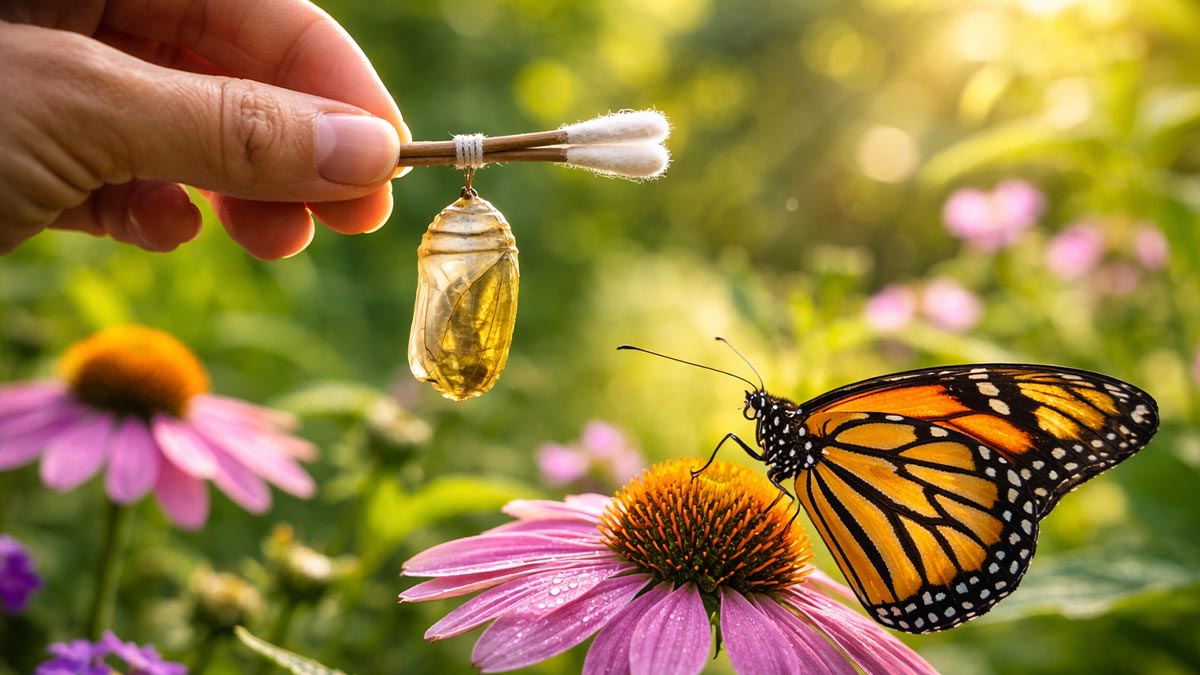
In a quiet backyard in South Texas, an ordinary day of watering plants turned into an unforgettable encounter with nature. A resident named Pam Lê Steele stumbled upon what initially looked like a small green lump in the soil. Upon closer inspection, she realized she had discovered something far more extraordinary—a butterfly chrysalis, quietly undergoing one of nature’s most fascinating transformations.
This unexpected moment soon became a powerful reminder of how delicate life can be and how small acts of care can make a meaningful difference.
What Is a Butterfly Chrysalis and Why It Matters
When a caterpillar reaches the final stage of its larval life, it forms a protective outer casing known as a chrysalis. Inside this shell, an incredible biological process takes place. The caterpillar breaks down and reorganizes its body through metamorphosis, eventually emerging as a fully developed butterfly.
This stage is extremely sensitive. The chrysalis must remain secure and properly positioned to allow the butterfly to emerge safely. If disturbed or left in an unsuitable environment, the insect may not survive.
An Unusual Discovery in the Soil
Pam Lê Steele was already familiar with caterpillars and butterflies, as she regularly welcomes them into her garden. However, what made this discovery unusual was the location of the chrysalis. Instead of being attached to a plant or elevated surface, it was lying directly on the ground.
This raised immediate concerns. A chrysalis placed in soil is vulnerable to moisture, predators, and physical damage. More importantly, without proper positioning, the butterfly may not be able to emerge successfully.
- → Nationwide Listeria Recall in France: What You Need to Know About Contaminated Pâtés and Cold Meats in 2026
- → The Unexpected Household Hack That Keeps Wet Floors and Entryways Clean in 2026
- → The Hair Transformation Women Over 50 Are Talking About in 2026: What Really Works for Thinning Hair
- → Marseille’s Mistral District in Crisis: Arrests, Secrets, and a Growing Mystery in 2026
- → Massive 35-Meter Waves in the Pacific: What Scientists Are Discovering in 2026
- → Why You’re Receiving More Spam Calls in 2026: The Hidden Reasons and How to Stop Them
- → The Express Chignon: A Quick and Elegant Hairstyle for Busy Women in 2026
Realizing the potential risk, she knew she had to act quickly.
Taking Action to Protect a Fragile Life
Determined to help, Steele carefully lifted the chrysalis using a paper towel to avoid causing any damage. She then improvised a simple but effective solution to secure it.
Using the soft fibers at the ends of two cotton swabs, she gently attached the chrysalis by its natural hook. Once stabilized, she placed it in a safe and sheltered area in her garden, hoping that her efforts would give the butterfly a chance to complete its transformation.
Her careful handling and quick thinking played a crucial role in protecting the developing insect.
Signs of Transformation Begin to Appear
By the following morning, Steele noticed a visible change in the chrysalis. Its color had shifted from a bright green to a darker shade with black and orange tones.
For those familiar with butterfly development, this is a promising sign. It indicates that the metamorphosis is progressing and that the butterfly inside is nearing the final stages of its transformation.
Encouraged by this change, Steele continued to monitor the chrysalis closely.
The Anticipation of Emergence
On the third day, it became clear that the butterfly was about to emerge. Steele found herself checking on it frequently, eager not to miss the moment.
She described feeling deeply invested in the process, choosing to stay nearby rather than go about her usual routine. The anticipation of witnessing the butterfly’s first moments added to the emotional significance of the experience.
However, life briefly pulled her away.
A Missed Moment but a Beautiful Surprise
Steele stepped away for less than an hour to have breakfast with her husband. When she returned, the chrysalis was empty.
At first, she felt disappointed, believing she had missed the most important moment. But that feeling quickly changed when she noticed a monarch butterfly nearby, gently testing its wings for the first time.
The butterfly had successfully emerged and was preparing for its new life.
A Meaningful Connection with Nature
The moment took on a deeper emotional meaning for Steele. After going through a challenging period in her personal life, seeing the butterfly felt symbolic—a sign of renewal, resilience, and hope.
She described the butterfly as lingering nearby, almost as if acknowledging her efforts. It did not immediately fly away and instead rested until she gently lifted it on her finger.
Only then did it take flight, marking the end of a brief but meaningful interaction between human and nature.
Why Monarch Butterflies Need Our Help in 2026
As of 2026, monarch butterfly populations continue to face serious challenges. Habitat loss, climate change, and declining milkweed availability have all contributed to their reduced numbers across North America.
Monarchs rely heavily on milkweed plants for laying eggs and feeding caterpillars. Without these plants, their life cycle cannot continue.
Conservation efforts have become increasingly important, and individuals can play a role by creating butterfly-friendly environments in their own gardens.
How to Create a Butterfly-Friendly Garden
If you want to attract and support butterflies like the one Steele helped, there are several simple steps you can take.
Planting native plants, especially milkweed, provides essential food sources and breeding grounds. Avoiding pesticides helps protect both caterpillars and adult butterflies. Creating sheltered spaces can also offer protection from wind and predators.
Even small spaces such as balconies can be adapted to support pollinators with the right plants.
The Importance of Small Acts in Conservation
Steele’s experience highlights how even a single act of care can have a meaningful impact. By noticing the chrysalis and taking steps to protect it, she helped ensure the survival of a butterfly that might not have otherwise made it.
These small actions, when multiplied across communities, can contribute to larger conservation efforts.
Conclusion
What began as a simple gardening moment turned into a powerful story of awareness, compassion, and connection with nature. Pam Lê Steele’s discovery of a butterfly chrysalis and her efforts to protect it demonstrate how attentive and thoughtful actions can support fragile life forms.
In a time when pollinators face increasing challenges, this story serves as a reminder that individuals can make a difference. By creating supportive environments and taking small steps to protect wildlife, we can help ensure that these beautiful creatures continue to thrive.
FAQs
What is a chrysalis
A chrysalis is the protective stage in a butterfly’s life cycle where a caterpillar transforms into an adult butterfly.
Why was the chrysalis in danger on the ground
A chrysalis on the ground may not be properly positioned for emergence and can be exposed to moisture, predators, and damage.
How long does it take for a butterfly to emerge
The process can take several days, depending on the species and environmental conditions.
Why are monarch butterflies declining
Habitat loss, climate change, and reduced availability of milkweed are major factors affecting their population.
How can I help butterflies in my area
Plant native flowers and milkweed, avoid pesticides, and create a safe environment for pollinators.




Leave a comment