

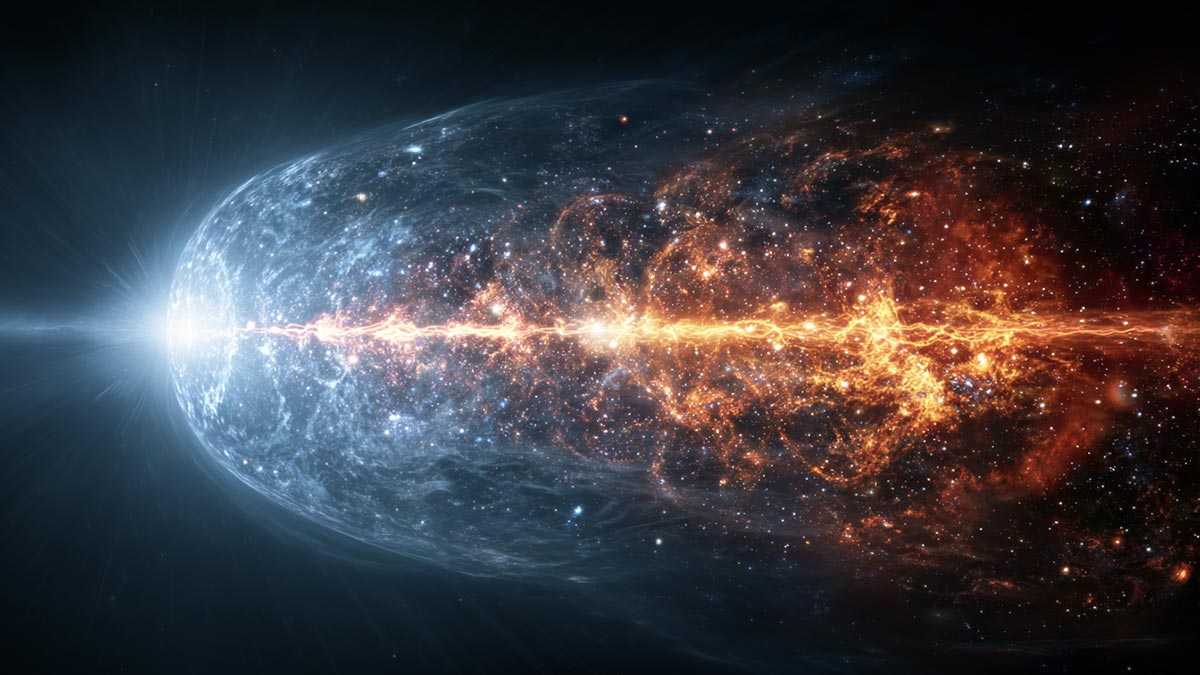
The universe has been keeping secrets for billions of years. Now, one of its oldest has finally surfaced. NASA astronomers have successfully detected an extraordinarily faint signal that traveled more than 13 billion years across space and time to reach us — offering humanity its most direct window yet into the cosmic dawn, the mysterious era when the very first stars and galaxies were beginning to take shape.
The signal, captured by researchers at NASA’s Goddard Space Flight Center using advanced radio telescopes, lasted just 10 seconds. But those 10 seconds carry more information about the origins of the universe than decades of prior observation. This is not just another astronomical milestone — it is a glimpse into the birth of everything.
A Message Older Than the Earth Itself
The signal is believed to have originated from a galaxy situated approximately 13.6 billion light-years from Earth. To put that in perspective, the light detected today was emitted when the universe was only a few hundred million years old — a tiny fraction of its current age of 13.8 billion years. Our own planet would not exist for another nine billion years after this signal was first sent out.
Scientists have compared the experience to receiving a letter from a civilization that existed billions of years before our solar system was even a cloud of dust. The sheer fact that this signal survived its journey across the expanding universe and arrived detectable at all is a stunning testament to how far radio astronomy has advanced. Researchers have likened the challenge of picking it up to trying to hear a whisper from across an ocean during a storm.
What Exactly Is the Cosmic Dawn?
To appreciate why this discovery matters so deeply, it helps to understand what the cosmic dawn actually was. In the earliest moments after the Big Bang, the universe was an unstructured sea of hot gas — primarily hydrogen and helium. There were no stars, no galaxies, no light sources of any kind.
Over hundreds of millions of years, gravity began pulling that primordial gas together into dense clumps, eventually triggering nuclear fusion and igniting the first stars. These first stellar objects illuminated an otherwise dark universe — an event astronomers refer to as the cosmic dawn. It is one of the least understood periods in the entire history of the cosmos, and direct observational evidence from that era has been extraordinarily difficult to obtain — until now.
Decoding the Signal: What the Data Reveals
The signal was detected at a wavelength of 21 centimeters — a measurement directly associated with hydrogen atoms transitioning between energy states. This particular wavelength is scientifically significant because hydrogen was the dominant element in the early universe, and its behavior during the cosmic dawn period holds critical clues about temperature, density, and chemical composition of the primordial environment.
The 10-second duration of the signal is also telling. Its brief nature suggests it was likely produced during a specific, discrete event — possibly the formation of an early star cluster, the collapse of a primordial gas cloud, or another defined moment of structural change in the early universe. Scientists are now working to narrow down exactly what triggered it.
Together, the wavelength and duration paint the beginnings of a detailed portrait of conditions that existed nearly 13.6 billion years ago — conditions that set the stage for every galaxy, star, and planet that followed.
What This Tells Us About the First Stars and Galaxies
One of the most valuable pieces of information embedded in this signal concerns the nature of the earliest celestial structures. Analysis suggests that the first stars and galaxies were significantly less luminous than the ones we observe in the modern universe. This reduced brightness is consistent with the theory that early stellar objects formed from primordial gas with a very different chemical makeup than the gas clouds that produce stars today.
In the early universe, heavier elements — the kind forged in the cores of aging stars over billions of years — had not yet been created in significant quantities. The first generation of stars formed almost entirely from hydrogen and helium, making them behave quite differently from contemporary stars. This signal appears to confirm that picture with direct observational evidence for the first time.
New Clues About Dark Matter
Among the signal’s most intriguing implications is what it might reveal about dark matter — the invisible, undetected substance that is believed to account for roughly 27 percent of the universe’s total mass and energy. Although dark matter has never been directly observed, its gravitational influence on visible matter is well documented.
By examining how this ancient signal interacts with the surrounding cosmic environment, researchers believe they can extract new information about how dark matter was distributed during the early universe and what role it played in driving the formation of the first galaxies. Every piece of data that constrains dark matter’s behavior in the early universe brings physicists closer to finally understanding what it actually is.
The Technical Achievement Behind the Discovery
Detecting a signal this faint from this far away required an extraordinary combination of instrument sensitivity and analytical precision. NASA’s team spent years refining both their radio telescope capabilities and their signal processing methodologies to make this kind of detection possible.
The telescopes used operate at wavelengths that allow them to cut through billions of light-years of cosmic noise to isolate individual signals from specific periods in the universe’s history. The researchers cross-referenced the detected signal against known cosmic background radiation patterns to confirm its authenticity and date its origin with confidence. It is a level of precision that would have been unimaginable just two decades ago.
- → Nationwide Listeria Recall in France: What You Need to Know About Contaminated Pâtés and Cold Meats in 2026
- → The Unexpected Household Hack That Keeps Wet Floors and Entryways Clean in 2026
- → The Hair Transformation Women Over 50 Are Talking About in 2026: What Really Works for Thinning Hair
- → Marseille’s Mistral District in Crisis: Arrests, Secrets, and a Growing Mystery in 2026
- → Massive 35-Meter Waves in the Pacific: What Scientists Are Discovering in 2026
- → Why You’re Receiving More Spam Calls in 2026: The Hidden Reasons and How to Stop Them
- → The Express Chignon: A Quick and Elegant Hairstyle for Busy Women in 2026
What Leading Scientists Are Saying
Dr. Sarah Moran of the Harvard-Smithsonian Center for Astrophysics described the find as opening an entirely new window into the early universe — comparing it to receiving a message from the dawn of creation with the power to reshape our understanding of how the cosmos formed.
Dr. Liam Keller, Director of the International Center for Radio Astronomy Research, highlighted the role of refined observational techniques in making this possible, noting that continued improvements in radio astronomy could unlock even deeper insights into the universe’s earliest evolutionary stages.
Dr. Amelia Chen, Chief Scientist at NASA’s Goddard Space Flight Center, framed the discovery as proof of what human curiosity and sustained scientific investment can achieve — bringing us closer to answering some of the most fundamental questions about where we came from and how the universe around us came to be.
What It Means for the Future of Astronomy
This discovery does more than answer old questions — it opens entirely new lines of inquiry and sets a new benchmark for what observational astronomy can achieve. The most immediate priority for researchers will be to search for additional signals from the cosmic dawn era, using the techniques refined during this detection as a template.
The data gathered will also directly inform the development and mission planning of next-generation observatories. The James Webb Space Telescope, already producing landmark imagery of the deep universe, and the planned Extremely Large Telescope are both expected to build on findings like this one. Future missions will be better calibrated to target the specific wavelengths and time periods that this signal has identified as scientifically rich.
The ability to detect and analyze signals from 13 billion years ago also raises an exciting possibility: that many more such transmissions are already traveling toward us, waiting to be captured by instruments sensitive enough to receive them.
Signal Characteristics at a Glance
| Characteristic | Detail | Significance |
|---|---|---|
| Wavelength | 21 cm | Linked to hydrogen energy transitions; reveals early universe composition |
| Duration | 10 seconds | Suggests a discrete early cosmic event |
| Origin Distance | 13.6 billion light-years | Emitted when the universe was only a few hundred million years old |
Conclusion
A 10-second signal from 13.6 billion years ago has done what decades of theoretical modeling could only attempt — it has handed astronomers a direct, observational connection to the cosmic dawn. From insights into the dimness of the first stars, to new constraints on dark matter’s early behavior, to confirmation of primordial hydrogen’s role in shaping the universe, this signal is dense with meaning that researchers will spend years fully unpacking.
More than a scientific breakthrough, this discovery is a reminder of the extraordinary reach of human curiosity. We built instruments sensitive enough to hear a whisper from the edge of time, and what we heard may ultimately reshape our understanding of how everything — stars, galaxies, planets, and life itself — came to exist. The universe spoke 13 billion years ago. We are only just learning to listen.
FAQs
Why is the 21 cm wavelength particularly important in this discovery? The 21 cm wavelength corresponds to hydrogen atoms shifting between energy states. Since hydrogen was the predominant element in the early universe, signals at this wavelength carry direct information about the temperature, density, and composition of the cosmos during the cosmic dawn period.
How were scientists able to detect such a faint signal from so far away? The detection required highly sensitive radio telescopes combined with sophisticated signal processing techniques developed over years of refinement. The NASA team cross-referenced the signal against cosmic background data to confirm its origin and rule out interference.
What does the signal reveal about the first stars and galaxies? It indicates that the earliest stellar structures were considerably less luminous than modern stars and galaxies, consistent with their formation from primordial hydrogen and helium gas rather than the chemically richer gas clouds that produce stars today.
How does this finding connect to our understanding of dark matter? By analyzing how the signal interacts with its surrounding environment, researchers can extract information about dark matter’s distribution and influence during the early universe — helping to narrow down theories about its true nature.
What will astronomers do next with this data? The immediate focus is on deeper analysis of the signal’s characteristics and a search for additional cosmic dawn signals using the refined detection methods developed for this discovery. The findings will also shape future mission planning for observatories like the James Webb Space Telescope.
How does this compare to other major recent astronomy discoveries? While discoveries like gravitational wave detection and black hole imaging were transformative, this signal is unique in providing a direct observational link to the cosmic dawn — the least understood and most scientifically significant period in the universe’s history.
Could there be more signals like this one waiting to be found? Almost certainly. Researchers believe that many similar signals from the early universe may be detectable with sufficiently advanced instruments, and this discovery has established a roadmap for identifying them.
What role will future telescopes play in following up on this discovery? The James Webb Space Telescope and the planned Extremely Large Telescope are expected to be instrumental in building on this finding, targeting the specific wavelengths and cosmic periods that this signal has highlighted as scientifically significant.




Leave a comment